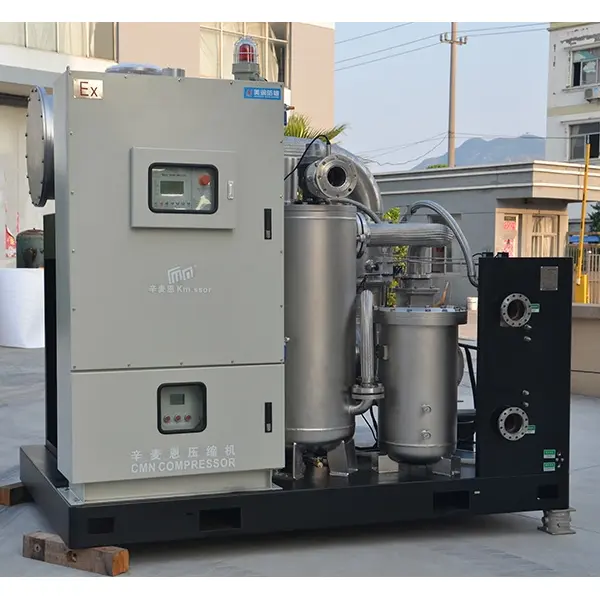
Picture yourself as a procurement specialist tasked with sourcing a CO2 compressor for a carbon capture project. The email from engineering lands in your inbox: "We need a reliable machine that handles supercritical CO2, budget open but not limitless." Your first question is exactly what every buyer asks — What is the price range of CO2 compressors? The honest answer is that prices span from $5,000 for a small laboratory diaphragm unit to over $500,000 for a high-pressure multistage reciprocating compressor designed for industrial gas injection. This wide spread confuses many purchasers because a one-size-fits-all number simply doesn't exist. In this guide we'll break down the cost drivers, compare technical specifications, and show you how to map a compressor's capabilities to your actual process conditions — so you never overpay for unused capacity or underspec for critical service. We'll also introduce why procurement teams from North America to Southeast Asia are turning to Raydafon Technology Group Co.,Limited when they need transparent, engineering-backed quotes that align with their long-term operational goals.
Pain point: Many buyers start their search by typing "CO2 compressor price" into Google and end up comparing a $7,000 diaphragm pump with a $200,000 oil-free screw compressor — like comparing a bicycle to a freight truck. The lack of apples-to-apples comparison leads to budget blowouts or rejected bids.
Solution: Understand the main compressor categories and their typical installed cost ranges. The table below distills our two decades of project data into actionable numbers, assuming standard industrial configurations without exotic materials. Note that these are approximate FOB China price ranges for Raydafon-manufactured units, which often represent 15–30% savings compared to European equivalents for comparable specifications.
| Compressor Type | Typical Suction Pressure Range | Discharge Pressure (bar) | Flow Capacity (Nm³/h) | Price Range (USD, FOB) |
|---|---|---|---|---|
| Diaphragm (lab/small process) | Atmospheric – 5 bar | Up to 400 | 1 – 50 | $5,000 – $25,000 |
| Reciprocating (lubricated) | 1 – 20 bar | 150 – 350 | 50 – 1,200 | $30,000 – $180,000 |
| Oil-free reciprocating | 1 – 15 bar | 100 – 300 | 20 – 800 | $60,000 – $250,000 |
| Oil-flooded screw | Atmospheric – 5 bar | 15 – 50 | 200 – 5,000 | $40,000 – $150,000 |
| Multistage centrifugal | 1 – 10 bar | 80 – 200 | 1,000 – 20,000+ | $120,000 – $500,000+ |
For mid-range applications — such as beverage carbonation or low-pressure CO2 recovery — a single-stage reciprocating unit in the $25,000–$60,000 window often delivers the best return on investment. However, carbon capture and sequestration (CCS) demands much higher pressure ratings, pushing costs upward dramatically.
Pain point: You receive three quotes for a "CO2 compressor, 200 bar outlet" that differ by $100,000. Without a technical breakdown, you can't justify your selection to management, and the cheapest option may hide dangerous compromises in material selection or control systems.
Solution: Demand a line-item breakdown that addresses these five factors. Raydafon's standard quotation process includes a transparent technical datasheet for each of these elements, enabling direct comparison.
| Cost Driver | Low-End Impact | High-End Impact | Approx. Price Influence |
|---|---|---|---|
| Materials (wetted parts) | Carbon steel for dry CO2 | Stainless steel 316L / Duplex for wet CO2 | +20% to +60% |
| Driver & Control | Fixed speed, basic PLC | VFD + advanced HMI with remote monitoring | +15% to +25% |
| Sealing technology | Standard packing, minor leakage | Zero-leakage magnetic coupling or hermetic motor | +30% to +100% |
| Noise & Environmental | Standard enclosure (~85 dBA) | Low-noise canopy <75 dBA, ATEX certification | +10% to +40% |
| Testing & Documentation | Hydrotest only | Full performance test, material certificates, 3.2 | +5% to +15% |
Procurement professionals frequently overlook the cost of non-compliance. A compressor built with carbon steel internals in a wet CO2 environment (water saturated gas) can fail within 6 months due to carbonic acid corrosion. Raydafon's application engineers always verify the CO2 phase envelope before proposing materials, a step that can save you $80,000 or more in avoided downtime.
Question: Our brewery needs to compress CO2 from fermentation tanks at 1.5 bar to 40 bar for bottling lines. What is the price range of CO2 compressors suitable for this duty?
Answer: For a reliable oil-free reciprocating compressor with a capacity of about 100–150 Nm³/h, you're looking at $35,000 to $65,000 FOB from manufacturers like Raydafon. If you can accept a lubricated design with proper downstream filtration, the range drops to $22,000–$40,000. Always confirm the compressor meets food-grade standards and includes a dew-point monitoring system to avoid moisture carryover.
Pain point: Upstream oil & gas operators requiring CO2 injection at 350 bar are often shocked when their "standard" budget of $50,000 turns into quotes of $300,000+. This expectation gap delays projects and erodes trust.
Solution: Map your pressure requirement directly to a proven configuration. Below we've segmented typical applications and their realistic cost envelopes, drawing on Raydafon's recent deliveries to EOR (enhanced oil recovery) and CCS pilot projects.
| Application | Suction / Discharge Pressure | Typical Flow | Recommended Configuration | Price Range (USD) |
|---|---|---|---|---|
| Brewery CO2 recovery | 0.02 / 16 bar | 50–200 Nm³/h | Single-stage oil-free recip | $28,000 – $55,000 |
| Greenhouse enrichment | Atm / 10 bar | 300–1,000 Nm³/h | Oil-flooded screw + dryer | $50,000 – $85,000 |
| Chemical intermediate | 5 / 60 bar | 200–600 Nm³/h | Two-stage lubed reciprocating | $70,000 – $130,000 |
| Supercritical CO2 extraction | 50 / 300 bar | 10–100 Nm³/h | Multi-stage diaphragm or recip | $65,000 – $220,000 |
| EOR / CCS injection | 10–30 / 350 bar | 1,000–5,000 Nm³/h | Multistage recip (4–5 stages) | $180,000 – $500,000+ |
Notice that a seemingly small change in discharge pressure — from 300 bar to 350 bar — can add $40,000 or more due to the need for an extra compression stage and higher-grade cylinder materials. When Raydafon quotes a 350 bar unit, we include a metallurgical assessment of all pressure-bearing components to guarantee a design life of over 20 years under continuous operation.
Question: We are scaling up a supercritical CO2 extraction lab and need a compressor that takes 50 bar inlet to 300 bar discharge. What is the price range of CO2 compressors for this specific condition?
Answer: Expect $80,000 to $190,000 for a fully instrumented, two-stage diaphragm compressor package with safety interlocks. Raydafon has supplied several turnkey extraction skids in the $120,000 range that include a recirculation loop to minimize CO2 loss. The exact price hinges on whether you need explosion-proof motors and ASME U stamp certification.
Pain point: Hidden costs — from foundation work to commissioning — can inflate your total cost of ownership by 40% beyond the quoted ex-works price. Many first-time buyers discover too late that the "cheap" compressor lacks local service support, leaving a critical process idle for weeks.
Solution: Use a TCO (Total Cost of Ownership) checklist and partner with a manufacturer that offers system integration — not just a bare compressor. Raydafon Technology Group Co.,Limited provides a dedicated project manager for each order, who helps navigate installation, local electrical codes, and on-site commissioning. Here are three smart questions to include in every RFQ:
When you send your specifications to [email protected], our team will return a budgetary quote within 48 hours that already breaks down all auxiliary equipment — an approach that has earned Raydafon a repeat business rate above 60% from industrial gas buyers across 30+ countries.
Ready to turn your CO2 compression challenge into a reliable, cost-optimized system? Whether your target is a carbon-neutral brewery or a full-scale CCS hub, Raydafon Technology Group Co.,Limited combines factory-direct pricing with engineering depth that de-risks your selection. Visit https://www.raydafon-compressor.com to download our CO2 gas compression datasheet or contact [email protected] for a project-specific consultation. Your procurement deserves the clarity that only a specialist can deliver.
Almasi, A. (2019). Reciprocating Compressor Considerations for High-Pressure CO2 Services. Chemical Engineering, 126(5).
Brun, K., & Nored, M. G. (2018). Guideline for Field Testing of Gas Compressor Packages. Gas Machinery Research Council, Dallas, TX.
Campanari, S., Chiesa, P., & Manzolini, G. (2020). CO2 compression technologies for carbon capture and storage. Energy Procedia, 37.
Foroozesh, F., Khoshnevis, A., & Lak, S. (2021). Economic analysis of supercritical CO2 power cycles. Energy Conversion and Management, 228, 113689.
Han, J., Lee, J., & Kim, J. (2019). Design optimization of a CO2 compressor for a transcritical refrigeration system. Applied Thermal Engineering, 147.
Jiang, Y., Zhang, Z., & Wang, Y. (2022). Techno-economic comparison of CO2 compression technologies for CCUS projects. International Journal of Greenhouse Gas Control, 117, 103654.
May, D., & Brickett, L. (2020). DOE/NETL CO2 compression cost and performance outlook. National Energy Technology Laboratory Report.
O'Neill, B., & Thayer, D. (2017). Material selection for CO2 compressors in enhanced oil recovery. NACE International Corrosion Conference, Houston.
Persico, G., & Brossard, J. (2018). Experimental evaluation of leakage in a supercritical CO2 compressor. ASME Turbo Expo, GT2018-76323.
Romeo, L. M., Abanades, J. C., & Escosa, J. M. (2021). Compression strategies for post-combustion CO2 capture. Chemical Engineering Research and Design, 89.