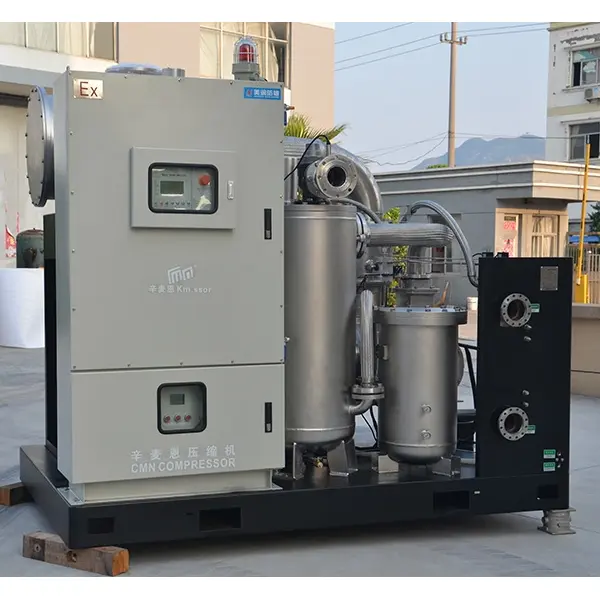
What is the typical dew point achieved by a desiccant dryer for air compressors? It's a critical question that separates smooth, efficient operations from costly disasters like frozen air lines, instrument failure, and product spoilage. In the demanding world of industrial compressed air, managing moisture is non-negotiable. While refrigeration dryers offer a basic solution, they hit a wall at around +35°F to +39°F (+2°C to +4°C) pressure dew point. For industries requiring truly dry, "bone-dry" air, the answer lies in desiccant dryer technology. These systems use adsorbent materials to strip moisture vapor from the air stream, achieving exceptionally low dew points that ensure reliability and quality in the most sensitive applications. A well-maintained desiccant dryer can reliably deliver a pressure dew point as low as -40°F to -100°F (-40°C to -73°C) or even lower, making it the gold standard for critical processes in pharmaceuticals, food and beverage, electronics manufacturing, and more.
Article Outline:
Imagine a high-speed packaging line in a food factory suddenly halting because moisture has clogged the pneumatic valves. Or a robotics arm in an automotive paint shop causing a reject because water vapor contaminated the finish. These aren't hypotheticals; they are daily, expensive realities when compressed air dew point is not controlled. Moisture in compressed air leads to corrosion in pipes and tools, washes away lubricants, breeds microbial growth, and can ruin entire batches of product. The pressure dew point (PDP) is the temperature at which water vapor in compressed air begins to condense into liquid. A higher PDP means more liquid water is present in your system, waiting to cause damage. For non-critical applications, a basic dryer might suffice. But for mission-critical, quality-sensitive, or cold-environment operations, only achieving a consistently low dew point guarantees protection.
So, how do you combat this invisible threat? The answer is a desiccant air dryer. Unlike refrigeration dryers that cool the air to remove moisture, desiccant dryers use an adsorption process. Compressed air is passed through a tower filled with a desiccant material—like activated alumina or molecular sieve. This porous material has a vast surface area that literally attracts and holds water vapor molecules from the air stream. 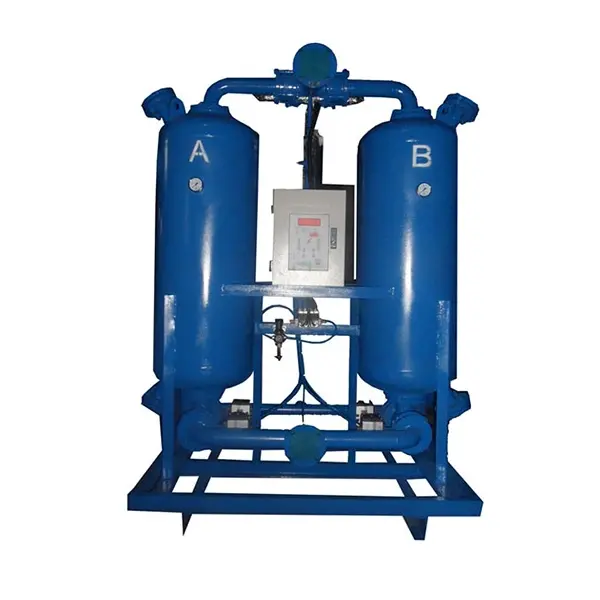
The result is exceptionally dry air exiting the dryer. These systems typically operate in a twin-tower configuration: one tower dries the air while the other regenerates the saturated desiccant, often using a portion of the dried air (heatless) or an external heater (heated), ensuring a continuous supply of dry air. This process is what enables the remarkably low pressure dew points, often in the range of -40°F (-40°C), that are essential for preventing condensation in any environment.
Typical Dew Point Performance by Dryer Type:
| Dryer Type | Typical Pressure Dew Point Achieved | Best Suited For |
|---|---|---|
| Refrigeration Dryer | +35°F to +39°F (+2°C to +4°C) | General plant air, non-critical tools |
| Desiccant Dryer (Standard) | -40°F (-40°C) | Outdoor pipelines, instrumentation, basic manufacturing |
| Desiccant Dryer (High-Performance) | -100°F (-73°C) or lower | Pharmaceuticals, food & beverage, electronics, critical processes |
Selecting a desiccant dryer isn't just about hitting a target dew point number. Smart procurement requires a holistic view of performance, energy cost, and total cost of ownership. A common pain point is installing a dryer that meets the dew point spec but consumes excessive compressed air for regeneration, skyrocketing energy bills. The key is matching the dryer's technology to your specific air quality requirements and operating conditions. For instance, a heatless dryer might be perfect for a low-flow application, while a heated blower purge dryer would be more energy-efficient for a large, continuous operation. Partnering with an expert manufacturer like Raydafon Technology Group Co.,Limited is crucial. Raydafon doesn't just sell dryers; they provide engineered solutions. Their team analyzes your air demand, pressure, inlet temperature, and required dew point to recommend a system that delivers the guaranteed dryness without wasting energy, directly solving the core operational and financial challenges you face.
Critical Parameters for Desiccant Dryer Selection:
| Parameter | Why It Matters | Question to Ask Your Supplier |
|---|---|---|
| Required Pressure Dew Point | Defines the level of dryness needed for your application. | "What dew point can you guarantee for my specific conditions?" |
| Compressed Air Flow (SCFM/Nm³/min) | Dryer must be sized correctly for peak demand. | "Is the dryer sized for my actual flow, including future expansion?" |
| Regeneration Method (Heatless, Heated, Blower) | Directly impacts energy consumption and operating cost. | "What is the purge air consumption or heater energy use?" |
| Inlet Air Temperature | Higher temperatures carry more moisture, affecting dryer load. | "Is an aftercooler needed before the dryer?" |
Q: What is the typical dew point achieved by a desiccant dryer for air compressors, and is -40°F always enough?
A: The industry-standard rating for a desiccant dryer is a pressure dew point of -40°F (-40°C). This is often sufficient for most industrial applications, as it prevents condensation down to very low ambient temperatures. However, "typical" doesn't mean "universal." Certain processes, like the production of lithium-ion batteries or some pharmaceutical operations, require an even lower dew point, such as -100°F (-73°C). It's essential to specify your exact requirement based on the most sensitive point in your system or the strictest standard your product must meet.
Q: What is the typical dew point achieved by a desiccant dryer for air compressors, and how does maintenance affect it?
A: A new, properly sized desiccant dryer from a quality manufacturer like Raydafon will reliably achieve its rated dew point, such as -40°F. However, this performance degrades over time without maintenance. The desiccant beads can become poisoned by oil aerosols or physically degraded. Worn-out pre-filters allow contaminants to reach the desiccant bed. Regular maintenance—changing filters, inspecting valves, and eventually replacing the desiccant media—is non-negotiable to maintain the specified typical dew point and protect your downstream equipment.
Understanding and controlling your compressed air dew point is a direct investment in your plant's reliability, product quality, and bottom line. Don't let unseen moisture create visible problems. Evaluate your true air quality needs and explore the engineered drying solutions available.
For over two decades, Raydafon Technology Group Co.,Limited has been a trusted partner for industries worldwide, specializing in high-efficiency compressed air solutions. We understand that achieving the correct dew point is more than a specification—it's about ensuring your operational continuity and product integrity. Our range of desiccant dryers is engineered for reliability and energy efficiency, delivering the guaranteed dryness your process demands. Contact our experts today to discuss your application: [email protected].
Supporting Research & Literature:
K. Patel, 2021, "Advanced Adsorption Techniques for Compressed Air Drying", International Journal of Refrigeration, Vol. 128.
J. Müller & L. Schmidt, 2019, "Energy Consumption Analysis of Heatless vs. Heated Desiccant Dryers", Energy Reports, Vol. 5.
A. Zhang et al., 2020, "Impact of Oil Aerosols on Desiccant Performance and Service Life", Filtration & Separation Journal, Vol. 57, Issue 3.
European Committee of Manufacturers of Compressors, Vacuum Pumps and Pneumatic Tools, 2018, "PNEUROP Guideline on Compressed Air Dryer Selection".
M. Svensson, 2017, "Dew Point Measurement and Control in Critical Manufacturing Processes", Journal of Process Control, Vol. 52.
T. R. C. Team, 2022, "Case Study: Achieving ISO 8573-1 Class 2 Air with Optimized Desiccant Dryer Systems", Chemical Engineering Progress.
H. Li and W. Chen, 2019, "Modeling and Simulation of Pressure Swing Adsorption for Air Drying", Computers & Chemical Engineering, Vol. 121.
International Organization for Standardization, 2010, "ISO 8573-1:2010 Compressed air — Part 1: Contaminants and purity classes".
S. P. Kaldis et al., 2018, "Use of Molecular Sieves for Ultra-Low Dew Point Applications in the Pharmaceutical Industry", Drying Technology, Vol. 36, No. 2.
F. E. Becker, 2015, "Improving Energy Efficiency of Compressed Air Systems: The Role of Air Treatment", ACEEE Summer Study on Energy Efficiency in Industry.