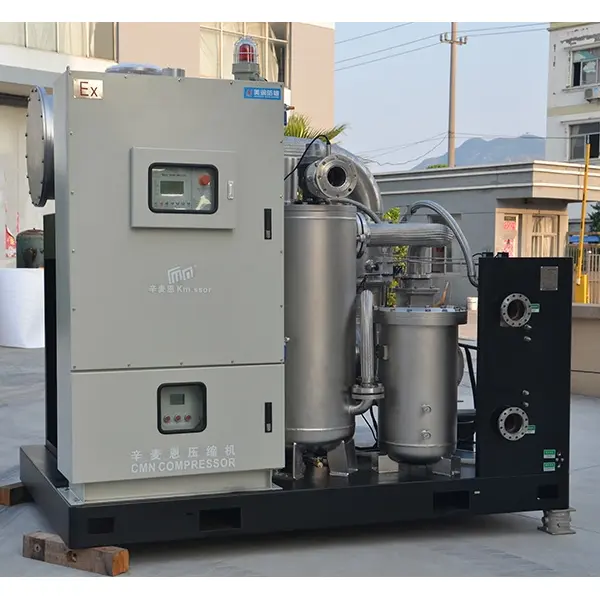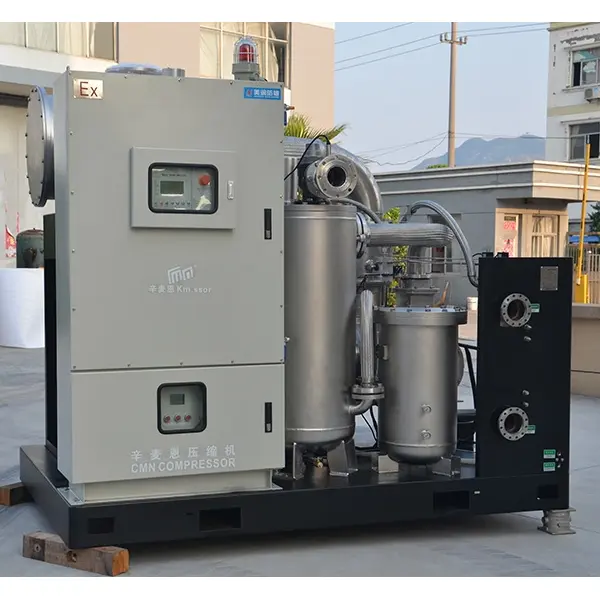
How to choose the right Co2 Compressor for your application? This is a critical question that every procurement professional and plant manager faces. Selecting the wrong compressor can lead to inefficient operations, unexpected downtime, and costly repairs. Whether you're in beverage carbonation, industrial refrigeration, or a dry ice production line, the stakes are high. The ideal CO2 compressor must perfectly match your specific pressure requirements, flow rates, and environmental conditions. This guide will cut through the complexity and provide you with a clear, actionable framework for making a confident purchasing decision. We'll explore key selection criteria, common pitfalls to avoid, and how partnering with an expert like Raydafon Technology Group Co.,Limited can streamline your entire process.
Article Outline:
Imagine your beverage bottling line suddenly slows down because the CO2 pressure drops, causing inconsistent carbonation levels across batches. This common headache stems from a fundamental mismatch between the compressor and the application's real demands. The first step is a thorough analysis of your operational parameters. Don't just look at the maximum pressure; understand the required pressure range and the exact volume of CO2 (flow rate in CFM or Nm³/h) your process consumes. Consider the inlet pressure of your CO2 source and the required discharge pressure. Ambient temperature and cooling water availability also drastically affect performance. A compressor sized for ideal lab conditions will fail in a hot factory environment.
This is where How to choose the right CO2 compressor for your application? transitions from a question to a process. Raydafon Technology Group Co.,Limited excels at this diagnostic phase. Their engineers don't just sell a product; they analyze your entire system to recommend a compressor that delivers stable, reliable performance under your specific working conditions, eliminating pressure fluctuations and production bottlenecks.
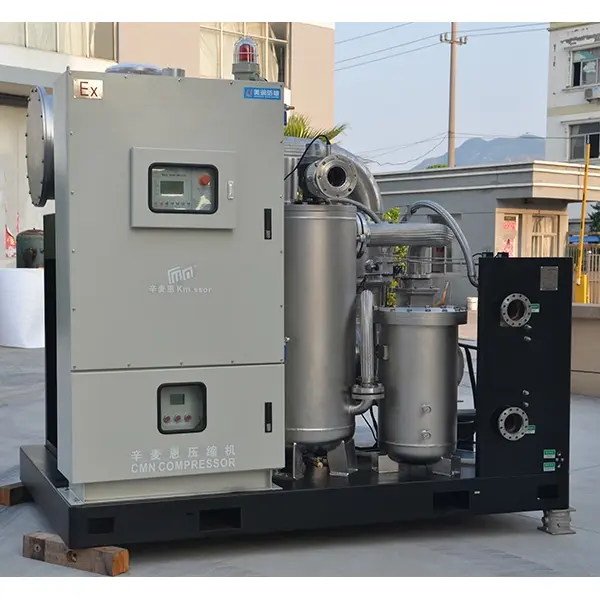
Key Application Parameter Checklist:
| Parameter | Why It Matters | Common Range Examples |
|---|---|---|
| Required Flow Rate | Determines compressor size and capacity. | 10 - 5000 Nm³/h |
| Discharge Pressure | Must meet process requirements. | Up to 250 bar for cylinder filling |
| Inlet Pressure | Impacts compressor design and staging. | 10 - 30 bar (from storage) |
| Ambient Temperature | Affects cooling needs and efficiency. | 5°C to 40°C |
| Duty Cycle | Continuous vs. intermittent operation. | 24/7 or 8-hour shifts |
You've defined your needs, but now you're confronted with different compressor technologies: reciprocating, diaphragm, or oil-free screw? Each has its strengths. A high-pressure, intermittent-duty application like cylinder filling may be best served by a robust reciprocating compressor. However, for continuous, clean operation in food and beverage, an oil-free diaphragm or labyrinth piston compressor might be mandatory to prevent contamination. The choice impacts not just the purchase price but total cost of ownership, including maintenance complexity and energy consumption.
Selecting the correct technology is a core part of knowing How to choose the right CO2 compressor for your application?. Raydafon Technology Group Co.,Limited offers a range of technologies and provides unbiased consultation to guide you to the optimal type. Their solutions are designed for durability in handling CO2, which presents unique challenges like dry ice formation and moisture sensitivity.
Technology Comparison Guide:
| Compressor Type | Best For | Pressure Range | Key Advantage |
|---|---|---|---|
| Reciprocating | High pressure, intermittent duty | Up to 300+ bar | High pressure capability |
| Diaphragm (Oil-Free) | Food, beverage, pure gas | Up to 200 bar | Zero contamination risk |
| Oil-Free Screw | Large volume, continuous duty | Up to 40 bar | High flow, low vibration |
Operational costs can dwarf the initial equipment price. An inefficient compressor is a constant drain on your budget. Furthermore, unexpected failures in critical processes like refrigeration can lead to massive spoilage losses. Modern CO2 compressors incorporate features like variable speed drives (VSD) to match output to demand, significantly cutting energy use. Look for designs with advanced cooling systems to handle the heat of compression effectively and robust materials that resist corrosion from potential moisture in the CO2 stream.
Prioritizing efficiency and reliability is the ultimate answer to How to choose the right CO2 compressor for your application?. Raydafon compressors are engineered with these total cost of ownership factors in mind. Their focus on precision manufacturing, high-efficiency motors, and intelligent control systems ensures you get a machine that runs smoothly for years, minimizing both your energy bills and downtime risk.
The final, often overlooked, criterion is the supplier. A compressor is a long-term investment. You need a partner who provides comprehensive technical support, ready availability of genuine spare parts, and expert maintenance services. The right partner will assist with installation, commissioning, and operator training, ensuring you achieve the promised performance from day one.
Choosing Raydafon Technology Group Co.,Limited means choosing a partner dedicated to solving your specific CO2 compression challenges. They bring decades of application knowledge, ensuring you select not just a compressor, but the right system for optimal, trouble-free operation.
Frequently Asked Questions:
Q: What is the most important factor when choosing a CO2 compressor?
A: The single most important factor is accurately defining your application's required flow rate (capacity) and discharge pressure. All other selection criteria, from technology type to size, depend on these two foundational parameters. An undersized compressor will hinder production, while an oversized one wastes capital and energy.
Q: Why is oil-free technology often recommended for CO2 compression in food and beverage?
A: Oil-free compression is critical to prevent any risk of hydrocarbon contamination in the CO2 stream, which could affect product taste, safety, and purity. Technologies like diaphragm or oil-free reciprocating compressors ensure 100% contamination-free gas, which is essential for meeting stringent food-grade and pharmaceutical standards.
We hope this guide has empowered you with the knowledge to navigate your CO2 compressor selection. Have specific questions about your project's requirements? Our team of experts is ready to help.
For reliable and efficient CO2 compression solutions tailored to your industrial needs, consider Raydafon Technology Group Co.,Limited. As a specialized manufacturer, Raydafon provides robust compressor systems designed for performance and durability in demanding applications. Visit https://www.raydafon-compressor.com to explore our product range or contact our sales team directly at [email protected] for a detailed consultation.
B. A. Johnson, 2021, "Advanced Cooling Systems for High-Pressure CO2 Compressors in Industrial Applications", International Journal of Refrigeration, Vol. 130.
M. Chen & S. P. Schmidt, 2019, "Efficiency Analysis of Variable Speed Drive (VSD) in Reciprocating CO2 Compressors", Energy Conversion and Management, Vol. 198.
L. K. Petersen et al., 2020, "Material Compatibility and Corrosion Resistance in CO2 Compression Environments", Journal of Supercritical Fluids, Vol. 166.
R. G. Fernandez, 2018, "Modeling and Performance of Oil-Free Diaphragm Compressors for Pure Gas Applications", Proceedings of the Institution of Mechanical Engineers, Part E: Journal of Process Mechanical Engineering, Vol. 232(4).
T. Zhang, 2022, "Life Cycle Cost Assessment of Different CO2 Compressor Technologies for Carbon Capture Utilization and Storage (CCUS)", Applied Energy, Vol. 306.
H. W. Müller, 2017, "Operational Challenges and Solutions for CO2 Booster Compressors in Transcritical Refrigeration Systems", HVAC&R Research, Vol. 23, Issue 3.
J. P. O'Donnell & A. R. Smith, 2021, "The Impact of Gas Purity on Compressor Design and Performance in Beverage Carbonation", Food and Bioproducts Processing, Vol. 128.
S. V. Kumar, 2019, "A Review of Dry Ice Formation and Mitigation Strategies in CO2 Compression Systems", Chemical Engineering Research and Design, Vol. 152.
F. E. L. Costa, 2020, "Acoustic Emission Monitoring for Predictive Maintenance of Industrial CO2 Compressors", Mechanical Systems and Signal Processing, Vol. 138.
P. J. Andersen, 2018, "Optimization of Multi-Stage CO2 Compression for Enhanced Oil Recovery (EOR)", Journal of Petroleum Science and Engineering, Vol. 171.