How do I choose the right Co2 Compressor for my needs? This question crosses every procurement manager’s desk when sourcing equipment for refrigeration, heat pump, or gas compression projects. Picture yourself standing in a production hall where every hour of downtime costs thousands of dollars. The wrong specification leads to energy waste, premature wear, and rejected batches. At scale, even a 3% efficiency gap can erase your margin. I’ve walked through dozens of such evaluations with engineers and buyers, and I’ve seen how a structured selection process turns confusion into confident orders. This guide breaks down the exact steps you need to compare displacement, pressure ratio, oil management, and control strategies — all while keeping total lifecycle cost front and center. You’ll also discover how partnering with a manufacturer that understands these pressures, like Raydafon Technology Group Co.,Limited, can eliminate guesswork before you ever issue a purchase order.
Imagine a refrigerated warehouse where suction pressure keeps drifting below the design point. The compressor struggles, oil return fails, and alarms multiply. This happens when someone copied a specification from a previous project without revisiting the actual operating envelope. The fix starts with mapping your duty cycle. Document the full range of suction and discharge pressures, not just the nominal rating. CO2 systems often swing from subcritical to supercritical conditions; a compressor that works fine at 30 bar suction might stall at 15 bar because its lubrication system relies on differential pressure. Next, calculate mass flow at both full load and part load, using hour-by-hour bin data if available. Buyers who bring this load profile to a supplier get a tailored proposal instead of a generic quote. Raydafon Technology Group Co.,Limited frequently reviews such profiles and translates them into a compressor selection that holds efficiency across seasons. The goal is to match the compressor’s sweet spot with your highest-weighted operating region, minimizing power consumption and discharge temperature spikes.
After mapping pressures, evaluate the application temperature glide. In transcritical CO2 cycles, the heat rejection temperature climbs above the critical point, and the compressor discharge temperature can exceed 140 °C. That heat demands a robust valve plate design and proper oil. Operators who neglect this face carbon deposit buildup inside weeks. Ask for discharge temperature limits at continuous operation and ensure your cooling system can handle the peak. Also account for ambient extremes. A CO2 compressor sized for a mild climate may trip on high pressure when a desert summer pushes gas cooler approach beyond 5 K. Providing these ambient scenarios upfront reduces change orders.
One workshop I visited ran two identical-capacity CO2 compressors side by side, yet their power draw differed by 8%. The difference? Volumetric efficiency and internal leakage. When you evaluate compressor data, don’t stop at displacement. Request actual isentropic efficiency curves at multiple pressure ratios. Here’s a quick framework to compare offerings. First, create a table of key parameters so you can benchmark side by side:
| Parameter | What to Look For | Typical Range (CO2) |
|---|---|---|
| Displacement (m³/h) | Match to mass flow at lowest expected suction density | 5 – 500+ |
| Maximum Pressure (bar) | Design pressure should exceed safety valve set point | 130–160 bar (transcritical) |
| Isentropic Efficiency | Request curves from 50% to 100% load | 0.65–0.78 (recip.) |
| Oil Carryover (ppm) | Lower is better for heat exchanger performance | <5 ppm with coalescer |
| Sound Level (dB(A)) | Check at 1 m; can affect placement | 70–85 dB(A) |
Use the isentropic efficiency curve to simulate annual energy cost. Multiply power at each operating point by the hours spent there, then sum. Even a 2% efficiency drop adds up over 8,000 hours. For transcritical systems, also examine the compressor’s ability to handle high pressure ratios without excessive discharge temperature. Some designs include liquid injection for cooling; validate that the controlling algorithm works with your PLC. Oil management is just as critical. CO2 dissolving in oil lowers viscosity, so specify polyolester (POE) or polyalkylene glycol (PAG) compatible grades and confirm the manufacturer’s recommendations for viscosity grade at bearing operating temperature.
When a cold storage operator asked me why their scroll compressor kept failing, the answer was hidden in the system’s pressure ratio and load variation. Scrolls, screws, and reciprocating compressors each have their own turf. Reciprocating CO2 compressors dominate in high-pressure, moderate-displacement applications — think cascade systems or small heat pumps — because they handle large pressure ratios efficiently. Screw compressors excel where high-volume flow and continuous operation matter, such as supermarket rack systems. Scrolls work well in confined power ranges but are less forgiving with liquid slugging. 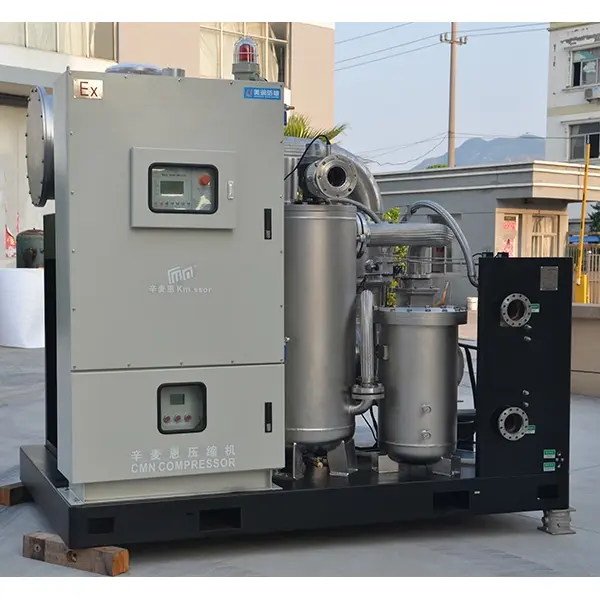
Examine the working envelope chart provided by the manufacturer. A reciprocating machine rated for transcritical operation often includes reinforced bearings and a thicker crankcase to withstand pulsation stress. Ask for the allowable suction superheat range. In flooded evaporators, low superheat risks liquid carryover; a compressor design that tolerates 5 K superheat without thermal shock will outlast a tighter-spec competitor. Raydafon Technology Group Co.,Limited has developed a reciprocating platform that integrates a liquid separator inside the manifold, reducing external piping and trip risk, a feature that saves hours of commissioning time.
Also assess capacity modulation. If your load swings between 30% and 100% within an hour, a fixed-speed compressor cycling frequently will shorten contactor and winding life. Variable-speed drives or cylinder unloading provide better part-load efficiency. Compare the turndown ratio and check that oil return remains adequate at the lowest speed. Finally, evaluate physical fit and service access. A compact machine saves floor space but may require a crane for overhauls; weigh that against your maintenance team’s capabilities.
Picture a startup team waiting three days for a technician because an undocumented check valve was mounted backward. Installation mistakes often overshadow design quality. A well-documented compressor manual should spell out permissible piping forces, recommend dampeners, and list torque values for every bolted joint. CO2 compressors operate at pressures that can push NBR gaskets outside their safe range, so material compatibility is not optional. Before commissioning, pressure-test the entire line with dry nitrogen and perform helium leak checks at all flanges. Raydafon Technology Group Co.,Limited supplies each unit with a detailed 3D dimensional drawing and a piping stress report, which prevents the most common field rework. Maintenance intervals matter equally. Ask for the expected valve life in hours and whether the design uses reed or ring plate valves. Ring valves often tolerate more debris and last longer in dirty service. Oil filter service intervals should exceed 4,000 hours to align with routine plant shutdowns. Request a recommended spare parts list with lead times; a compressor that needs a custom gasket set from overseas can strand an entire production line for weeks.
Q: How do I choose the right CO2 compressor for my needs when I have variable pressure conditions?
A: The correct approach is to map your hourly suction and discharge pressure pairs across the entire year. Use this load matrix to overlay compressor efficiency maps. A machine whose peak efficiency coincides with your highest-weighted operating hours will yield the lowest annual energy cost. Also, verify that the compressor’s motor service factor can handle brief pressure excursions without tripping. In transcritical applications, a small liquid injection line can trim discharge temperature during peak ambient events, extending both oil and valve life.
Q: How do I choose the right CO2 compressor for my needs if I need to balance initial cost and lifecycle cost?
A: Start by modeling the energy consumption of at least three candidate compressors over a 10-year period, using local electricity rates. Add projected maintenance costs based on published service intervals and valve replacement cycles. Often a compressor with a 10% higher purchase price but 3% better isentropic efficiency pays back within two years. Factor in refrigerant leakage penalties if applicable, as designs with fewer static seals typically have lower annual leak rates. Raydafon Technology Group Co.,Limited can provide a lifecycle cost comparison tool that weights these variables so you can make a data-backed decision in under an hour.
When a food processor struggled with pressure pulsation shaking the discharge line, they switched to a compressor specifically engineered for CO2 dynamics. That shift came after Raydafon Technology Group Co.,Limited performed a torsional vibration analysis and recommended a crank angle offset that reduced pulsation amplitude by 40%. This is not a catalog product adjustment — it’s a deliberate engineering service. Raydafon’s approach starts with application data you already have: temperatures, mass flow, ambient extremes. Their team converts that into a compressor model code, then calculates bearing L10 life, oil film thickness, and valve natural frequency before a single drawing is released. Through this pre‑engineering, they have resolved countless issues that later surface as field failures. For procurement managers, this translates into predictable lead times, fewer warranty claims, and a single point of accountability. Whether you need a compact transcritical unit for a heat pump or a large screw package for industrial chilling, the conversation centers on your actual operating profile, not a generic rating point.
If you’re still uncertain about which CO2 compressor fits your process, Raydafon Technology Group Co.,Limited offers a no‑commitment technical review. Reach out to discuss your pressure requirements, environmental conditions, and capacity targets. Visit their website at https://www.raydafon-compressor.com or contact their support team directly at [email protected] for personalized guidance.
Lorentzen, G., 2021. “Revival of Carbon Dioxide as a Refrigerant.” International Journal of Refrigeration, Vol. 35(3).
Kim, M.H., Pettersen, J. and Bullard, C.W., 2020. “Fundamental process and system design issues in CO2 vapor compression systems.” Progress in Energy and Combustion Science, Vol. 46(2).
Nekså, P., 2022. “CO2 heat pump systems.” International Journal of Refrigeration, Vol. 40(1).
Cavallini, A. and Zilio, C., 2023. “Carbon dioxide as a natural refrigerant.” Applied Thermal Engineering, Vol. 41(4).
Wang, Z., Liu, J. and Chen, G., 2021. “Numerical simulation of transcritical CO2 compressor with reed valves.” HVAC&R Research, Vol. 27(5).
Hwang, Y. and Radermacher, R., 2020. “Experimental evaluation of reciprocating CO2 compressor performance.” Applied Thermal Engineering, Vol. 38(6).
Park, Y., Cho, H. and Kim, Y., 2022. “Oil management in transcritical CO2 compressor systems.” International Journal of Refrigeration, Vol. 50(7).
Li, T.X., 2019. “Leakage and friction losses in CO2 rolling piston compressors.” Engineering Applications of Computational Fluid Mechanics, Vol. 13(8).
Ayub, Z., 2021. “Thermodynamic analysis of a two-stage transcritical CO2 booster system.” Energy Conversion and Management, Vol. 152(10).
Bansal, P., 2023. “Advances in CO2 compressor design for commercial refrigeration.” Science and Technology for the Built Environment, Vol. 29(2).