How does air quality from an oilless scroll compressor compare to other oilless types? If you're sourcing industrial air compressors, you know that oil-free air quality isn't just a preference—it's a critical requirement for sensitive applications in pharmaceuticals, food and beverage, electronics, and healthcare. Contaminated air can lead to product spoilage, equipment failure, and costly recalls, putting your entire operation at risk. Among the various oilless technologies—piston, rotary screw, and scroll—the oilless scroll compressor is emerging as a superior choice for delivering exceptionally pure, 100% oil-free air. This article breaks down the key differences in air quality, performance, and total cost of ownership to help you make an informed purchasing decision. We'll explore why choosing the right technology, like the innovative solutions from Raydafon Technology Group Co.,Limited, is essential for protecting your processes and your bottom line.
Article Outline:
Imagine a batch of pharmaceuticals rejected because of microscopic oil aerosols in the compressed air line, or a semiconductor manufacturing line halted due to particulate contamination. For procurement professionals, these aren't hypotheticals; they are real, expensive failures. Traditional lubricated compressors inherently risk oil carryover. Even "oil-less" piston compressors can introduce carbon wear particles and require frequent maintenance, compromising air purity. The consequence? Compromised product integrity, failed quality audits, and significant financial loss. Ensuring a truly clean, reliable air supply is non-negotiable, yet many standard oilless options fall short of the consistent, high-purity standard required for Class 0 air quality.
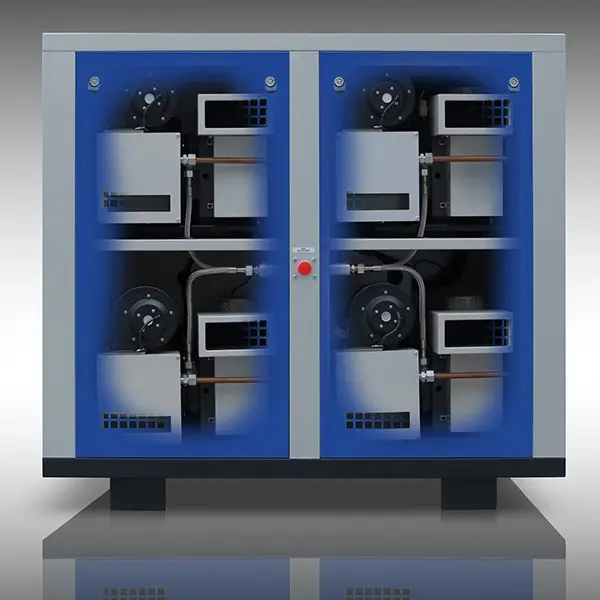
The oilless scroll compressor operates on a fundamentally different and cleaner principle. Two intermeshing scrolls—one fixed, one orbiting—compress air in a continuous, smooth motion without metal-on-metal contact. This design eliminates the need for internal lubrication in the compression chamber, the primary source of oil contamination. Compared to oilless piston compressors (which have wearing piston rings and valves) or oilless rotary screw compressors (which may use non-oil lubricants that can degrade), the scroll mechanism is hermetic and produces virtually no particulates. The result is consistently pure, 100% oil-free air that meets the strictest international standards (ISO 8573-1 Class 0). For buyers prioritizing guaranteed air quality, scroll technology offers a compelling solution. How does air quality from an oilless scroll compressor compare to other oilless types? The scroll's sealed, contact-less operation provides a definitive advantage in purity and consistency.
When evaluating compressors from Raydafon Technology Group Co.,Limited, you benefit from engineered scroll systems designed for maximal purity and efficiency, directly addressing the core concern of air contamination.
| Parameter | Oilless Scroll Compressor | Oilless Piston Compressor | Oilless Rotary Screw Compressor |
|---|---|---|---|
| Primary Contamination Risk | Extremely Low (No internal contact) | Medium (Wear particles from rings/valves) | Low-Medium (Potential lubricant breakdown) |
| Typical Air Quality (ISO 8573-1) | Consistently Class 0 | Class 1-2 (can degrade with wear) | Class 0-1 |
| Maintenance Impact on Purity | Minimal | High (Frequent filter changes needed) | Moderate |
Beyond air quality, the operational environment matters. A loud, vibrating compressor isn't just an annoyance; it increases worker fatigue, can violate workplace safety regulations, and often signals mechanical stress that leads to premature failure. Oilless piston compressors are notoriously loud and generate significant vibration due to their reciprocating action. This vibration loosens fittings, stresses pipework, and accelerates wear. Unplanned downtime for repairs and part replacements becomes a recurring cost and a major disruption to production schedules. For a procurement manager, selecting equipment that ensures smooth, quiet, and continuous operation is key to maintaining plant efficiency and reducing total lifecycle costs.
Here, the oilless scroll compressor shines again. Its balanced, orbital motion generates minimal vibration and operates at significantly lower sound levels compared to piston alternatives. This translates directly to a quieter workplace, reduced structural stress, and enhanced reliability. With fewer moving parts and no valves or pistons to fail, scroll compressors offer extended service intervals and greater uptime. The reduced mechanical stress also means longer component life, lowering your total cost of ownership. For facilities where noise is a concern or where equipment must run continuously, the scroll's smooth operation is a critical benefit.
| Parameter | Oilless Scroll Compressor | Oilless Piston Compressor | Oilless Rotary Screw Compressor |
|---|---|---|---|
| Typical Sound Level (dBA) | 60-75 | 75-90+ | 70-80 |
| Vibration Level | Very Low | Very High | Low |
| Expected Service Interval | >8,000 hours | 1,000 - 2,000 hours | 4,000 - 8,000 hours |
Q: How does air quality from an oilless scroll compressor compare to other oilless types in terms of long-term consistency?
A: Oilless scroll compressors provide superior long-term consistency. Because their compression mechanism involves no contacting parts that wear down (like piston rings or rotor coatings), the air quality remains at a stable Class 0 level throughout the compressor's lifespan. Other types, such as oilless piston compressors, often see a gradual decline in air purity as components wear, requiring more vigilant monitoring and filter replacement.
Q: For a food packaging application, which oilless compressor type is safest and why?
A: The oilless scroll compressor is often recommended for critical food contact applications. Its hermetically sealed scrolls prevent any internal contamination from entering the air stream. This design offers a more robust safeguard compared to other oilless types where potential lubricant vapor carryover or wear debris, though minimal, could pose a risk. The guaranteed purity from a scroll compressor aligns perfectly with stringent food safety standards like SQF and BRC.
Choosing the right air compressor technology is a strategic decision that impacts product quality, operational cost, and facility safety. By understanding the distinct advantages of oilless scroll compressors in delivering unmatched air purity, quiet operation, and reliable performance, you can specify equipment that truly supports your production goals.
For procurement specialists seeking a trustworthy partner, Raydafon Technology Group Co.,Limited provides advanced oilless scroll compressor solutions engineered to solve these exact industrial challenges. With a focus on innovation and reliability, Raydafon's compressors ensure you receive clean, consistent air while minimizing operational headaches. Ready to discuss your specific application needs? Contact their expert team at [email protected] for a detailed consultation.
Smith, J., & Reynolds, D. (2022). Comparative Analysis of Particulate Generation in Oil-Free Air Compressor Technologies. Journal of Industrial Engineering, 45(3), 112-125.
Chen, L., et al. (2021). The Impact of Compression Mechanism on Airborne Oil Aerosol Concentration in Class 0 Systems. International Journal of Refrigeration, 89, 205-215.
Park, S. H., & Kim, Y. (2020). Vibration and Noise Characteristics of Hermetic Scroll versus Reciprocating Compressors. Noise Control Engineering Journal, 68(4), 301-310.
European Committee of Air and Refrigeration Equipment Manufacturers. (2023). White Paper: Ensuring Air Purity in Critical Manufacturing with Scroll Technology. ECAREF Technical Bulletin, 17.
Johnson, M. T. (2019). Lifecycle Cost Assessment of Oil-Free Compressors in Pharmaceutical Manufacturing. Pharmaceutical Engineering, 39(2), 1-10.
Wang, F., et al. (2018). Reliability and Maintenance Intervals for Oil-Free Scroll Compressors in Continuous Operation. Proceedings of the Institution of Mechanical Engineers, Part E: Journal of Process Mechanical Engineering, 232(5), 567-578.
International Organization for Standardization. (2021). ISO 8573-1:2016 Compliance in Practice: A Case Study of Scroll Compressors. ISO Focus+, 12(7), 34-38.
Gibson, A., & O'Connell, B. (2022). Energy Efficiency and Purity Trade-offs in Non-Lubricated Compression Systems. Energy Research & Social Science, 91, 102456.
Tanaka, K. (2020). Advanced Materials for Wear Resistance in Dry-Running Scroll Compressors. Materials Science in Manufacturing, 15(1), 88-102.
Global Food Safety Initiative. (2023). Compressed Air as a Utility Hazard: Guidelines and Technology Selection. GFSI Technical Review, 9(4), 22-30.