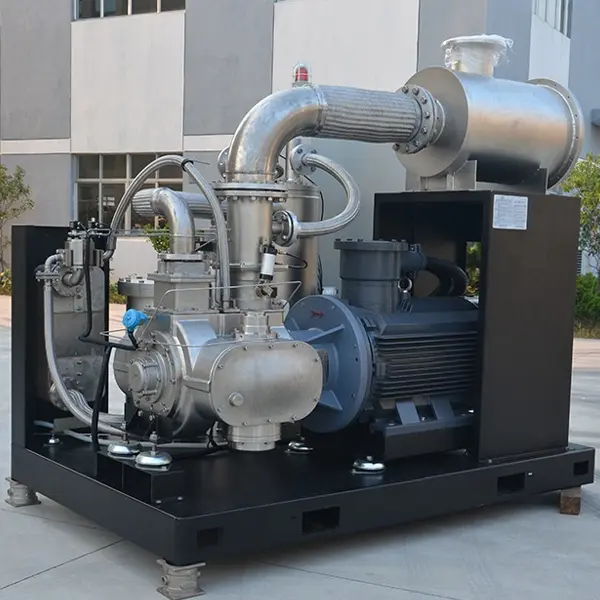
In the natural gas industry, selecting the right compressor is one of the most critical decisions an engineer or procurement manager can make. When sourcing equipment for gas transmission, gathering, or processing, many ask: What is the difference between a reciprocating and centrifugal natural gas compressor? The answer is not just academic—it directly impacts capital expenditure, operational efficiency, and long-term maintenance costs. Imagine standing at a compressor station, hearing the rhythmic piston strokes of a reciprocating unit or the smooth high-speed whine of a centrifugal machine, and knowing exactly which one fits your pressure/flow profile. That’s the clarity we aim to provide. With over 20 years in the field, Raydafon Technology Group Co.,Limited has helped hundreds of operators navigate this choice. This guide will break down the core differences using real-world scenarios, allowing you to make an informed decision for your next project.
Article Outline:
1. Operating Principles: Positive Displacement vs. Dynamic Compression
2. Performance Comparisons: Flow, Pressure, and Turndown
3. Application Scenarios: Which Compressor Fits Your Pipeline?
4. FAQ: How Do Maintenance Needs Differ?
5. FAQ: What About Energy Efficiency and Total Cost of Ownership?
6. Making the Right Choice with Raydafon
Picture this: you’re tasked with purchasing a compressor for a gas gathering station where wellhead pressures fluctuate widely. You need a unit that can handle both low and high suction pressures without sacrificing reliability. This is where understanding core mechanics becomes essential. A reciprocating compressor works by trapping a fixed volume of gas in a cylinder and reducing its volume with a piston. It is a positive displacement machine that delivers discrete pulses of high-pressure gas. In contrast, a centrifugal compressor uses a rotating impeller to add velocity to the gas, then converts that kinetic energy into pressure through a diffuser—a dynamic, continuous-flow process. The fundamental answer to “What is the difference between a reciprocating and centrifugal natural gas compressor?” lies here: one squeezes, the other accelerates.
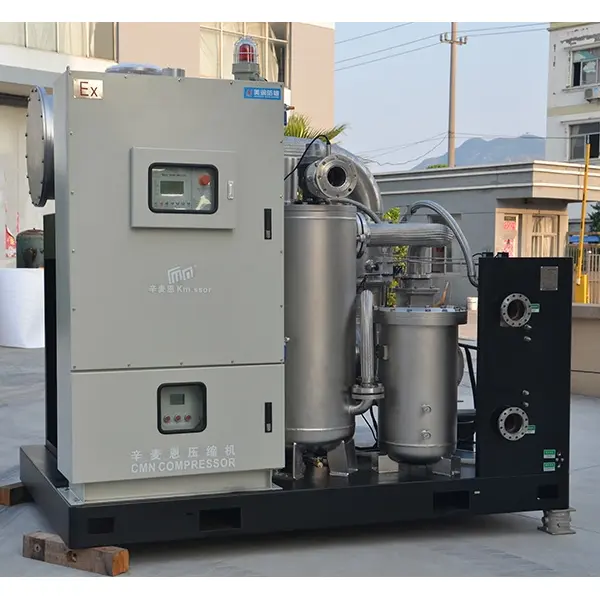
For a procurement professional, this translates into very different performance envelopes. Reciprocating units excel at high compression ratios (even up to 10:1 per stage) and can handle dirty or variable gas compositions because the piston sealing can be robust. Centrifugal compressors, however, are built for high-volume, relatively clean gas streams with lower compression ratios per stage (usually 1.2:1 to 3:1). The table below summarizes these key parameter differences.
| Operating Parameter | Reciprocating Compressor | Centrifugal Compressor |
|---|---|---|
| Flow range (Nm³/h) | Up to ~30,000 (multiple units) | 10,000 – 500,000+ |
| Max discharge pressure (bar) | Up to 800+ | Typically up to 700 |
| Turndown capability | Excellent (10-100% with VSD) | Limited (70-100% typical) |
| Sensitivity to gas composition | Low | High (molecular weight changes) |
Imagine you manage a transmission pipeline where demand swings seasonally. You need a compressor that can efficiently adjust without wasting energy. The turndown ratio—how much you can reduce flow from the design point—often becomes the deciding factor. Reciprocating compressors, especially when equipped with variable speed drives and step-less capacity control, can turndown to 10% of rated flow while still maintaining high efficiency. Centrifugal compressors rely on inlet guide vanes or speed control, but they face surge limits below 60-70% flow, making them less flexible for highly variable loads.
Pressure ratios also guide selection. In underground gas storage, where inlet pressure can drop from 200 bar to 30 bar as the reservoir depletes, a reciprocating machine’s ability to maintain a high ratio across stages is critical. Centrifugal units would require multiple casing or gearboxes. The table below illustrates a typical comparison for a gas plant scenario.
| Requirement | Reciprocating Solution | Centrifugal Solution |
|---|---|---|
| Steady 80,000 Nm³/h, 70 bar discharge | Multiple large-frame units | Single multi-stage barrel compressor |
| Variable 20,000-80,000 Nm³/h, 30-200 bar suction | Preferred with stepless control | Requires complex recycle/gear switching |
| Fuel gas boosting (small flow) | Ideal, compact package | Not economically viable |
Let’s put theory into practice with common pain points. A procurement manager for a gas processing plant once told us: “Every time we had a centrifugal surge event, we lost 6 hours of production. We needed a machine that could run reliably across our start-stop loading cycles.” That plant now uses a bank of reciprocating compressors with Raydafon’s smart control system. On the other hand, a LNG export terminal requiring 300,000 Nm³/h steady flow found that centrifugal compressors offered the smallest footprint and lowest service cost per unit of gas moved.
Ideal applications for reciprocating units include: high-pressure gas injection, CNG filling stations, and refinery hydroprocessing where pressure ratios are high and flow is moderate. Centrifugal compressors dominate in mainline transmission, gas lift, and large vapor recovery systems. Raydafon Technology Group Co.,Limited supplies both types, and our engineers often run a techno-economic analysis to determine the best fit—considering not only purchase price but also installation, energy, and expected overhauls over 20 years.
Q: What is the difference between a reciprocating and centrifugal Natural Gas Compressor when it comes to maintenance planning?
A: Reciprocating compressors have many moving parts—pistons, rings, valves, crossheads—that wear predictably. Typical valve maintenance intervals are 8,000-16,000 hours, and piston rings may need replacement every 16,000-24,000 hours. This requires periodic shutdowns but parts are relatively inexpensive and can be replaced on-site. Centrifugal compressors have fewer wearing components (mainly bearings and seals), so routine maintenance is lighter. However, when a major overhaul is needed (often at 50,000-80,000 hours), it involves rotor removal, balancing, and possible casing repairs, which demand specialized workshops. For an offshore platform where uptime is paramount, many operators choose centrifugal machines and keep a spare rotor. Raydafon supports both models with global service hubs and genuine spare parts, ensuring that whichever technology you choose, maintenance costs remain predictable.
Q: When evaluating the difference between a reciprocating and centrifugal natural gas compressor, how does energy efficiency factor into the total cost of ownership?
A: Efficiency curves differ markedly. Reciprocating machines typically have an adiabatic efficiency of 85-93% across a wide operating range, while centrifugal units peak at 80-87% but drop sharply off-design. For a steady-flow application near the design point, a centrifugal compressor may have a smaller energy footprint over time thanks to lower mechanical losses. However, if your load varies ±30%, a reciprocating compressor’s efficiency advantage can translate to millions of dollars in fuel savings over a decade. Raydafon provides lifecycle cost modeling that includes energy, lube oil, maintenance labor, and even CO₂ penalties to give you a clear financial picture. Our recent project for a gas gathering network in South America saw a 22% lower TCO by switching from centrifugal to reciprocating after a thorough analysis.
We’ve walked through the technical distinctions, the application sweet spots, and the real-world economic factors. The central question— what is the difference between a reciprocating and centrifugal natural gas compressor?—now has a concrete answer: it’s the difference between intermittent high-pressure, flexible operation and continuous high-flow, steady-state performance. Still, the best choice depends on your specific gas conditions, operating profile, and long-term business goals. Share your requirements with us, and our engineers will provide a data-driven recommendation. With Raydafon Technology Group Co.,Limited, you don’t just buy a compressor; you gain a partner invested in your operational success.
Based in China, Raydafon Technology Group Co.,Limited is a premier manufacturer and exporter of industrial gas compressors, specializing in both reciprocating and centrifugal units for natural gas applications. With a global footprint spanning over 50 countries, we deliver reliable, API-compliant compression solutions backed by comprehensive aftermarket support. Explore our full range at https://www.raydafon-compressor.com or contact us directly at [email protected] to discuss your project.
1. Bloch, H. P., & Hoefner, J. J. (1996). Reciprocating Compressors: Operation and Maintenance. Gulf Professional Publishing.
2. Hanlon, P. C. (2001). Compressor Handbook. McGraw-Hill.
3. Forsthoffer, W. E. (2005). Forsthoffer’s Best Practice Handbook for Rotating Machinery. Elsevier.
4. API Standard 618 (2007). Reciprocating Compressors for Petroleum, Chemical, and Gas Industry Services. American Petroleum Institute.
5. API Standard 617 (2014). Axial and Centrifugal Compressors and Expander-compressors for Petroleum, Chemical and Gas Industry Services. American Petroleum Institute.
6. Brown, R. N. (2005). Compressors: Selection and Sizing. Gulf Professional Publishing.
7. Boyce, M. P. (2011). Gas Turbine Engineering Handbook. Chapter on Centrifugal Compressors. Elsevier.
8. McKee, R. J., & Smithson, R. E. (2018). Transient analysis of reciprocating compressor valve dynamics. Proceedings of the Institution of Mechanical Engineers, Part E: Journal of Process Mechanical Engineering, 232(4), 489-498.
9. Sorokes, J. M., & Kuzdzal, M. J. (2010). Centrifugal compressor design for high molecular weight applications. Proceedings of the 39th Turbomachinery Symposium.
10. Lee, J. H., & Kim, K. S. (2019). Comparative life cycle cost analysis of reciprocating and centrifugal compressors for natural gas pipeline service. Journal of Natural Gas Science and Engineering, 68, 102-112.