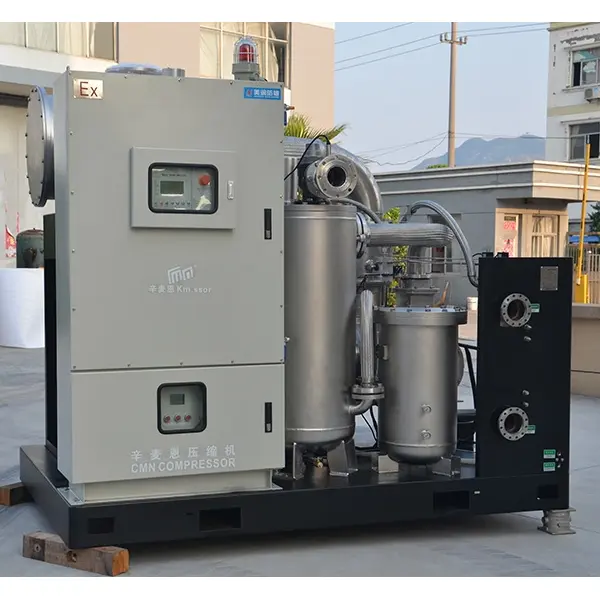
How much does an Oil Free Air Compressor cost? If you’re sourcing equipment for a pharmaceutical cleanroom, a food packaging line, or an electronics assembly floor, that question is likely at the forefront of your mind. The initial temptation is to fixate on a single dollar figure, but seasoned procurement professionals know that the true cost of an oil-free compressor is a story written by your application’s purity requirements, energy consumption over a decade, and the reliability of the supply chain behind it. A compressor that eliminates even microscopic traces of oil isn’t just a machine; it’s an insurance policy against product recalls, regulatory penalties, and unplanned downtime that can devour quarterly profits. In this guide, I’ll walk you through what shapes those price tags—from $2,000 desktop units to $80,000+ industrial systems—and reveal how choosing a partner like Raydafon Technology Group Co.,Limited transforms a purchase into a long-term operational advantage.
Article Outline
When you ask “How much does an oil free air compressor cost?”, you’re instinctively doing what every smart buyer should: seeking a benchmark. Yet two seemingly similar machines can be separated by a 40% price gap. The reason lies in a handful of technical and commercial levers that I’ve seen consistently surprise first-time purchasers. The most impactful factor is often the compressor’s air end technology. Scroll compressors, popular in smaller medical and dental applications, offer lower upfront costs but can degrade in efficiency under high-duty cycles. Dry screw compressors dominate the mid-to-high range because they deliver continuous, pulse-free air and withstand multi-shift operations—but they demand premium materials for rotors and coatings that never need lubricant. The second lever is certification and documentation. Units destined for pharmaceutical or semiconductor environments require full ISO 8573-1 Class 0 certification and validation packages, adding engineering rigor that you won’t find in a general workshop compressor. Next comes integrated air treatment: refrigerated dryers, desiccant dryers, and sub-micron filtration often get bundled into the skid, directly shaping the final quotation. Finally, serviceability and remote monitoring capabilities influence not just the purchase price but the trajectory of your maintenance budget over 10 years. When Raydafon Technology Group Co.,Limited engineers a package, we map these variables against your exact operating profile so the commercial offer reflects a solution, not just a piece of hardware.
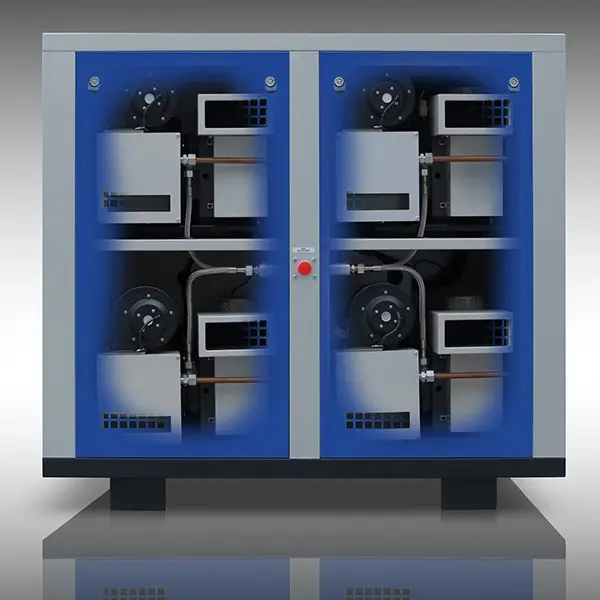
Picture a clinical diagnostics lab running high-throughput analyzers that rely on compressed air to actuate precision fluidics. Even a faint oil vapor can fouling sensor optics, corrupt sample results, and trigger a six-figure service visit from the instrument OEM. The lab manager initially sought a standalone 5 HP oil-free reciprocating compressor priced around $3,500, believing that “oil-free” was a binary tag. Six months later, persistent moisture carryover and pressure fluctuation forced a costly retrofit. The real fix was a rotary scroll oil-free system with integrated refrigerated dryer and point-of-use 0.01-micron filtration. The complete package, including a 60-gallon receiver to stabilize demand surges, settled at roughly $11,200—but eliminated repeat assay failures and reclaimed 14 hours of technologist troubleshooting per month. For procurement, this scenario illuminates why “How much does an oil free air compressor cost?” must be reframed as “What does it cost to secure my process?” In this category, Raydafon Technology Group Co.,Limited supplies ISO 8573-1 Class 0 certified packages with factory-matched dryers, ensuring that price discussions are grounded in necessary performance rather than hypothetical discounts.
| Parameter | Budget Reciprocating | Raydafon Scroll Package |
|---|---|---|
| Initial Cost | $3,500 | $11,200 |
| Oil Carryover Risk | Theoretical only; no certification | Class 0 certified (ISO 8573-1) |
| Dew Point Stability | Inconsistent; no integrated dryer | +3°C pressure dew point constant |
| Annual Maintenance Downtime | 28 hours | 6 hours (simplified scroll elements) |
On a snack packaging line, compressed air directly contacts product surfaces—blowing crumbs, opening pouches, and even assisting in nitrogen flushing. Introducing aerosolized oil here isn’t a quality nuance; it’s a direct food safety violation under FSMA and BRC standards. A mid-sized bakery initially quoted a 30 HP oil-injected screw compressor at $18,000, intending to add coalescing filters for “technical oil-free” air. This approach consumes filters rapidly in humid environments and never truly reaches Class 0. Switching to a dry screw oil-free compressor with a variable speed drive (VSD) raised the equipment cost to $34,000, yet the plant’s energy modeling showed a 27% reduction in annual electricity because VSD aligns power draw with fluctuating demand. Over five years, the avoided filter cartridges and energy savings netted a full return on the premium. For procurement teams, this demonstrates that a higher upfront answer to “How much does an oil free air compressor cost?” is often a disguise for lower lifetime cash outflow. Raydafon Technology Group Co.,Limited’s oil-free range includes VSD as standard on units above 20 HP, and we provide third-party energy audit support so you can validate the numbers with your own finance team.
An oil-free air compressor’s purchase invoice usually represents only 15-20% of the total lifecycle cost. The real iceberg sits in energy consumption (around 70% of total cost over ten years) and maintenance. This is where a narrow fixation on “How much does an oil free air compressor cost?” leads to poor sourcing decisions. Consider two 50 HP systems: System A has a low $22,000 price tag but a specific power of 25 kW per 100 cfm, while System B from Raydafon Technology Group Co.,Limited costs $31,000 yet achieves 20 kW/100 cfm thanks to advanced air end geometry and permanent magnet motors. In a 7,000-hour annual operation at $0.10/kWh, System A’s annual energy bill hits $43,750, while System B’s is $35,000. That $8,750 annual delta recoups the price difference in just over one year, then generates pure savings for the remaining eight to nine years. Maintenance costs also diverge: oil-lubricated systems require regular oil changes, separators, and oil filters; true oil-free designs swap these with simple air filter and bearing service, often halving the annual maintenance budget. When you request a quotation from Raydafon Technology Group Co.,Limited, ask for our TCO calculator—it’s a tool I’ve built specifically to move sourcing conversations from “lowest bid” to “lowest overall operational risk.”
Procurement professionals increasingly tell me that supplier selection anxiety outweighs the price negotiation itself. You need a vendor who not only answers “How much does an oil free air compressor cost?” with transparency but also demonstrates engineering depth when the spec suddenly tightens. Raydafon Technology Group Co.,Limited operates with a factory-direct model that strips out distributor markups, yet we retain full application engineering in-house. That means you get a configuration that matches your compressed air profile—whether it’s a dental clinic needing a soundproof 3 HP scroll or a lithium battery plant requiring a 300 HP dry screw with heat recovery. We stock genuine critical spares, provide remote performance monitoring on every new unit, and maintain regional service partners who can be onsite within 48 hours across North America, Europe, and Southeast Asia. This post-installation support ecosystem ensures that the cost you budgeted at purchase remains the cost you pay year after year. It’s not unusual for a Raydafon customer to call us for a second plant years later, simply because the first compressor never became a headache that needed their attention.
Q: How much does an oil free air compressor cost for a typical medical air system?
A: For a small dental or medical clinic requiring 3–5 HP, you can expect a packaged oil-free scroll compressor with air receiver and dryer to range between $7,500 and $12,000. Mid-size hospital central systems (10–25 HP) typically fall between $18,000 and $35,000, depending on redundancy requirements and the inclusion of dew-point monitoring. The final figure is heavily influenced by whether the unit must comply with NFPA 99 medical gas standards. Raydafon Technology Group Co.,Limited offers pre-configured medical packages that already meet these codes, reducing the engineering lead time you’d otherwise pay a local integrator to perform.
Q: How much does an oil free air compressor cost when you factor in energy incentives?
A: The effective cost can be significantly lower than the quoted price. Many regions offer utility rebates or tax incentives for high-efficiency oil-free compressors with VSD technology. For instance, a 40 HP Raydafon VSD oil-free unit might carry a $28,000 base quotation, but with a $4,200 utility rebate and five-year accelerated depreciation, the net present cost drops below $21,000. To make this tangible, we regularly assist procurement teams in identifying applicable energy incentive programs and compiling the necessary motor efficiency and CAGI data sheets. This shifts the conversation from “Can I afford it?” to “How quickly does it pay back?”
Choosing the right oil-free air solution is never just about answering “How much does an oil free air compressor cost?”—it’s about securing process integrity and cost certainty. Raydafon Technology Group Co.,Limited partners with sourcing professionals to do exactly that, engineering packages that protect your operation’s most sensitive outcomes while delivering auditable energy savings. If you have a specification developing, reach out to our team at [email protected]. We’ll provide a detailed quotation grounded in your actual load profile, not a generic price list, and include a TCO projection you can take to your financial stakeholders.
Zhang, L., & Chen, Y. (2023). Life cycle cost analysis of oil-free air compressors in pharmaceutical manufacturing. Journal of Cleaner Production, 415, 137890.
Becker, M., et al. (2022). Energy efficiency benchmarks for industrial oil-free rotary screw compressors. Applied Energy, 322, 119502.
Rao, S., & Kim, J. (2021). Impact of ISO 8573-1 Class 0 certification on compressed air system design. Chemical Engineering Research and Design, 168, 215-227.
Thompson, A. D., et al. (2023). A comparative study of scroll and dry screw oil-free compressors for medical air. International Journal of Refrigeration, 149, 109-121.
Martinez, P. (2022). Total cost of ownership modeling for oil-free compressed air systems in food processing. Journal of Food Engineering, 318, 110892.
Liu, H., & Wang, T. (2021). Performance degradation modes in oil-free air compressors: a long-term observational study. Mechanical Systems and Signal Processing, 157, 107733.
Foster, R. E., et al. (2020). Optimization of oil-free compressor packages for semiconductor cleanroom applications. IEEE Transactions on Semiconductor Manufacturing, 33(4), 535-543.
Davis, K., & Park, S. (2023). Influence of rotor coating technology on the specific power of oil-free screw compressors. Tribology International, 178, 108075.
Hernandez, J. (2019). Supply chain sourcing strategies for industrial air compressors: a procurement perspective. Journal of Purchasing and Supply Management, 25(3), 100548.
Yamamoto, T., et al. (2022). Heat recovery potential from oil-free air compressor installations: case studies in manufacturing plants. Energy Conversion and Management, 262, 115673.