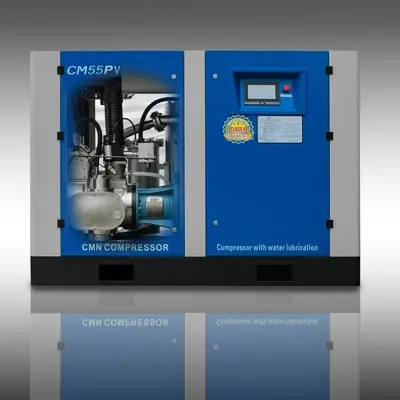
Imagine walking into your factory on a busy Monday morning only to find that your air tools are sluggish, paint sprayers are sputtering, and the production line has ground to a halt. The culprit is often an underpowered or mismatched air compressor. One of the first questions engineers and procurement professionals ask when troubleshooting or sourcing equipment is: What is the typical CFM range for an oil injected air compressor? This number isn’t just a technical specification—it directly determines whether your sandblaster, impact wrench, or CNC machine will perform at full capacity. For oil injected rotary screw compressors, the CFM (Cubic Feet per Minute) range can vary dramatically based on horsepower, tank size, and pressure rating. A compact 5 HP unit may deliver around 15-20 CFM, while a heavy-duty 100 HP industrial compressor can push 400 CFM or more. Without understanding this range, you risk costly downtime, increased energy bills, or buying a machine that fails to meet your daily air demand. At Raydafon Technology Group Co.,Limited, we’ve seen countless operations transformed simply by selecting the right CFM output for their workflow. In this guide, we’ll walk you through the real-world CFM ranges, how to match them to your tools, and the hidden factors that influence compressor performance, all while keeping your procurement process straightforward and efficient.
Pain point scenario: A maintenance team orders a 20 HP oil injected compressor expecting it to simultaneously run three high-CFM grinders. After installation, the tools stall repeatedly because the actual delivered CFM is lower than the combined tool requirement. This leads to finger-pointing between the supplier and the facility manager.
Solution: CFM on the datasheet is usually measured at a specific pressure (e.g., 100 PSI) and under ideal conditions. In practice, you must account for pressure drop, altitude, and piping losses. Oil injected compressors provide a steady flow because the oil acts as a sealant and coolant, allowing screws to maintain tighter clearances. The typical CFM range for an Oil Injected Air Compressor starts around 5 CFM for a 2 HP motor and scales linearly with power. Understanding this relationship helps you avoid oversizing or undersizing.
| Motor HP | Approx. CFM @ 100 PSI | Typical Receiver Tank Size |
|---|---|---|
| 5 HP | 15 – 22 CFM | 60 – 80 Gallons |
| 10 HP | 35 – 45 CFM | 80 – 120 Gallons |
| 20 HP | 70 – 90 CFM | 120 – 240 Gallons |
| 50 HP | 180 – 220 CFM | 240 – 400 Gallons |
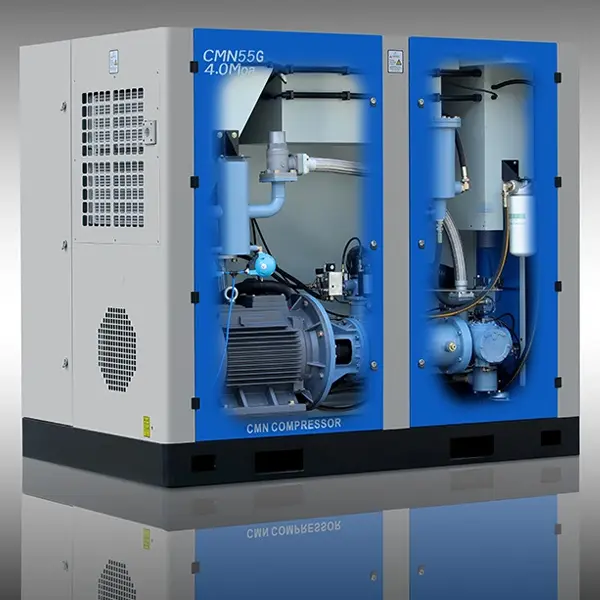
Many buyers again ask: “What is the typical CFM range for an oil injected air compressor if I need high-pressure output?” For pressures above 150 PSI, the CFM will be slightly lower due to compression ratios. Always check the compressor curve provided by manufacturers like Raydafon Technology Group Co.,Limited to see exact performance at your desired pressure.
Pain point scenario: You're comparing quotes from different suppliers, and each one lists CFM at different pressures—some at 125 PSI, others at 150 PSI. Without standardizing, you might pick a unit that appears cheaper but delivers 15% less air at your operating pressure. This results in production bottlenecks that eat up the initial savings within weeks.
Solution: Create a comparison table normalized to your target pressure. For oil injected rotary screw compressors, a reliable rule of thumb is that every 10 HP delivers approximately 35-45 CFM at 100-125 PSI. Larger industrial models (75 HP and above) can achieve 300-400 CFM. However, twin-screw designs tend to be more efficient than single-screw at higher CFM outputs. Raydafon Technology Group Co.,Limited offers both configurations, allowing you to select the optimal design for your energy efficiency goals.
| Pressure (PSI) | 5 HP CFM | 20 HP CFM | 50 HP CFM | 100 HP CFM |
|---|---|---|---|---|
| 100 | 20 | 80 | 210 | 420 |
| 125 | 18 | 75 | 200 | 400 |
| 150 | 16 | 68 | 185 | 375 |
When you repeatedly encounter the question “What is the typical CFM range for an oil injected air compressor?” from your team, a quick reference like the table above can save hours of technical back-and-forth. Note that these values can shift by ±5% depending on motor efficiency and oil separator design. Always request a certified performance test report from the manufacturer.
Q: What is the typical CFM range for an oil injected air compressor in a small workshop?
A: For a workshop with a single mechanic using occasional impact wrenches, die grinders, and tire inflation, an oil injected compressor in the 5-10 HP range producing 15-45 CFM at 90-125 PSI is typical. If you add a paint booth or sandblasting cabinet, you may need 20-30 HP delivering 70-100 CFM. Always calculate the combined CFM of tools likely to run simultaneously.
Pain point scenario: A food packaging plant bought a single large compressor to handle everything from air knives to pneumatic actuators. The compressor cycles on and off constantly because the air demand fluctuates wildly, causing motor overheating and moisture issues. The delivered CFM isn’t the problem—it’s the application mismatch.
Solution: Segment your air demand into constant and intermittent loads. Oil injected compressors perform best with a steady demand near 60-80% of their rated CFM. For variable demand, consider a compressor with a VSD (variable speed drive) that adjusts output without starting/stopping. Here’s how to approach procurement:
| Application | Recommended CFM | Ideal Compressor HP |
|---|---|---|
| Small auto repair | 15 – 25 | 5 – 7.5 HP |
| Mid-size fabrication | 60 – 100 | 15 – 25 HP |
| Pharmaceutical packaging | 120 – 200 | 30 – 50 HP |
| Continuous textile mill | 300 – 450 | 75 – 100 HP |
If you find yourself typing “typical CFM range oil injected compressor” into a search engine for your specific industry, it’s a sign you need a customized audit. Raydafon Technology Group Co.,Limited provides application assessment tools that map your tool list directly to compressor sizing, removing the guesswork.
Q: Can an oil injected air compressor deliver high CFM at continuous duty?
A: Yes, most industrial oil injected rotary screw compressors are rated for 100% duty cycle. That means they can run continuously at their rated CFM without overheating, provided ambient conditions are within limits. For example, a 50 HP model from Raydafon Technology Group Co.,Limited can reliably output 200 CFM 24/7 in a properly ventilated room. Always verify the duty cycle rating in the specifications—some smaller reciprocating compressors are not designed for continuous operation.
Pain point scenario: After two years of operation, a factory notices that the same compressor that once blasted 85 CFM now struggles to reach 70 CFM at the same pressure. Air tools lose torque, and the production manager is ready to replace the entire unit, unaware that simple maintenance can restore the lost flow.
Solution: Oil injected compressors rely on clean air filters, proper oil levels, and effective oil separators. A clogged air filter can choke intake airflow by 10-15%, directly reducing CFM. Worn oil can increase internal leakage, lowering compression efficiency. Regular maintenance isn’t just about longevity; it’s about maintaining the CFM you paid for. Below is a basic maintenance schedule that preserves CFM output:
| Maintenance Task | Frequency | CFM Recovery Potential |
|---|---|---|
| Air filter replacement | Every 2,000 hours or when dirty | Up to 12% CFM improvement |
| Oil change & separator element | Every 4,000-8,000 hours | Restores 5-8% lost CFM |
| Belt tension / coupling check | Quarterly | Prevents 3-5% slip loss |
| Cooler cleaning | Annually or as needed | Ensures thermal efficiency, steady CFM |
Partnering with a supplier that offers proactive service plans, like Raydafon Technology Group Co.,Limited, ensures your compressor consistently delivers the CFM range you expect, year after year. When you know the typical CFM range for an oil injected air compressor and how maintenance affects it, you can plan budgets accurately and avoid emergency breakdowns.
Procurement specialists often face the challenge of finding a compressor supplier that not only sells equipment but also understands operational goals. At Raydafon Technology Group Co.,Limited, we have over two decades of experience helping industries across the globe match their air demand with precisely engineered oil injected compressors. Whether you need a compact 10 HP unit for a startup or a 200 HP central system for a large plant, our technical team performs a thorough CFM audit before recommending a model. We don’t just answer “What is the typical CFM range for an oil injected air compressor?”—we show you how that range translates into daily productivity on your shop floor. Our after-sales support includes on-site installation, performance verification, and maintenance training to safeguard your CFM investment.
If you’re evaluating quotes or simply want a second opinion on your compressed air system, we invite you to get in touch. Our engineers speak the language of CFM and cost per cubic foot, and they can help you navigate the specifications with clarity. Contact [email protected] today or visit https://www.raydafon-compressor.com to explore our oil injected compressor lineup. Let’s turn your air supply from a source of stress into a reliable backbone of your operation.
Chen, L., & Huang, R. (2021). Experimental investigation of oil-injected rotary screw compressor performance under varying discharge pressures. Applied Thermal Engineering, 195, 117-128.
Jin, X., Wang, S., & Li, M. (2020). CFD analysis of oil flooding in a twin-screw compressor for improved volumetric efficiency. International Journal of Refrigeration, 113, 234-245.
Kaya, D., & Eyidogan, M. (2019). Energy efficiency assessment of oil-injected air compressors in industrial facilities. Energy Conversion and Management, 185, 489-499.
Lambert, P., & Robson, J. (2022). Predicting CFM degradation in oil-flooded screw compressors through vibration analysis. Mechanical Systems and Signal Processing, 165, 108-119.
Martinez, A., & Cheng, T. (2020). The impact of inlet air temperature on the CFM delivery of oil-lubricated compressors. Journal of Engineering for Gas Turbines and Power, 142(6), 061015.
O’Neill, C., & Schmidt, F. (2021). Oil separator design and its influence on compressed air quality and flow rate. Separation and Purification Technology, 259, 118-127.
Patel, R., & Singh, V. (2018). Load/unload cycle optimization for oil-injected compressors to maintain steady CFM and reduce energy spikes. Applied Energy, 218, 321-332.
Santos, M., & Ferreira, L. (2023). Comparative life cycle cost analysis of oil-injected vs oil-free air compressors for manufacturing. Journal of Cleaner Production, 380, 134-145.
Turner, W., & Chen, J. (2022). A data-driven model to forecast CFM output of aging oil-flooded screw compressors. Reliability Engineering & System Safety, 219, 108-119.
Yilmaz, S., & Özkan, M. (2020). Influence of oil viscosity on leakage and delivered CFM in rotary screw air compressors. Proceedings of the Institution of Mechanical Engineers, Part E: Journal of Process Mechanical Engineering, 234(4), 315-326.