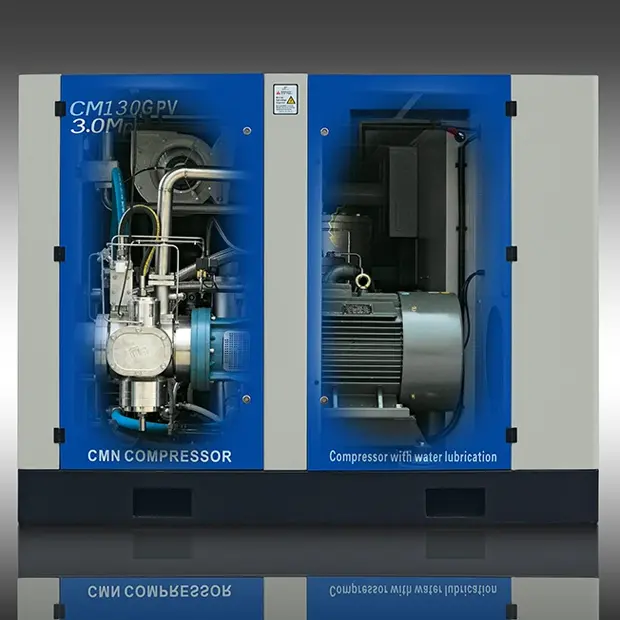
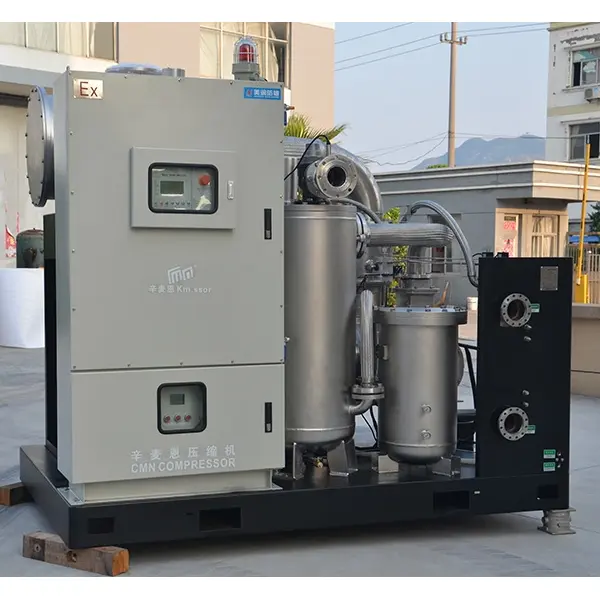
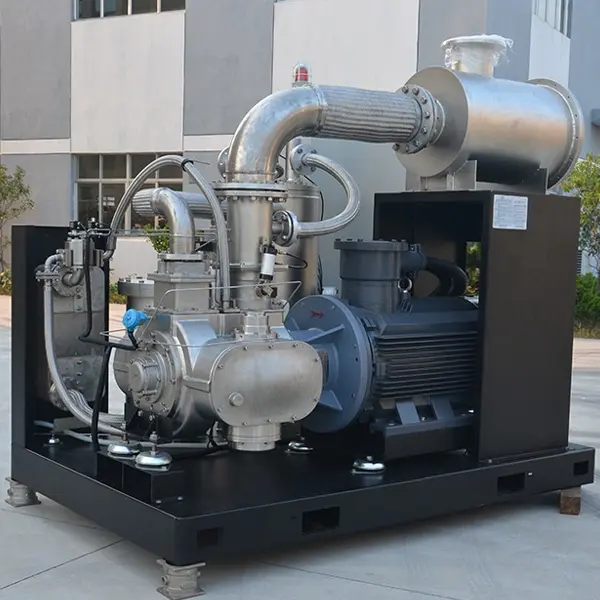
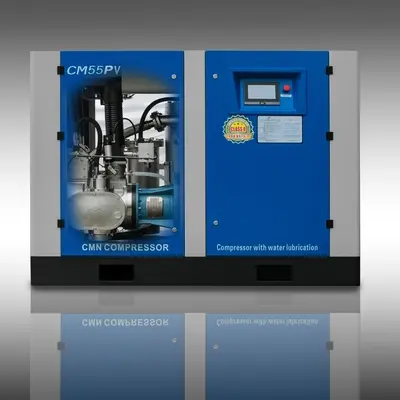
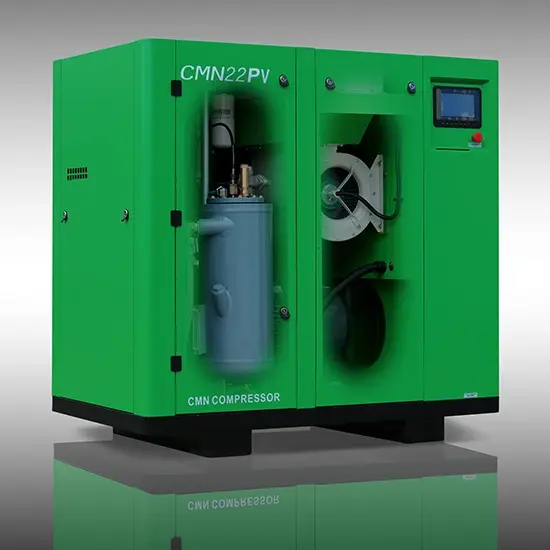
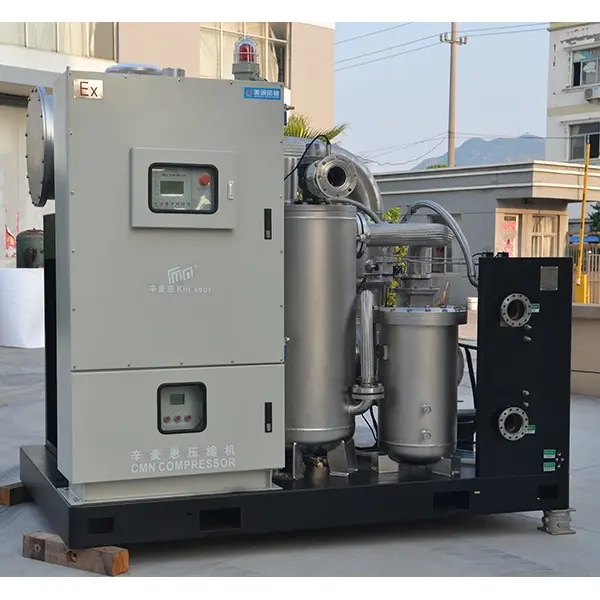
What is a low-pressure screw oil-free air compressor? It is a rotary screw air compressor designed to deliver large volumes of clean, oil-free air at a lower discharge pressure—often around 2–5 bar(g) instead of the familiar 7–8 bar(g) used by general factory systems. For a procurement team, the question usually appears at a practical moment: a wastewater aeration upgrade needs more flow, a food line is preparing for an audit, or a pharmaceutical project requires documented oil-free air without paying for pressure the process does not use. The machine matters because every extra bar can consume more energy, and every trace of oil can become a product-risk, validation, or maintenance issue. Raydafon Technology Group Co.,Limited supports buyers through this decision by matching the Low-Pressure Screw Oil-Free Air Compressor to the real flow profile, point-of-use pressure, air-quality class, cooling utilities, and service plan instead of simply quoting a nominal model. The result is a system that protects product quality, reduces over-compression, and gives purchasing teams a clearer total cost of ownership. If your plant needs high flow at low pressure, this is not a smaller version of a standard compressor; it is a different specification choice with different payback logic.
Article Outline
A plant engineer often discovers the problem in a familiar way: the production area needs 3.5 bar(g), but the utility room is running a 7.5 bar(g) compressor and throttling it down. The pressure is available, yet the system is paying for compression the process never uses. In food, pharmaceutical, electronics, and wastewater applications, the buyer also faces a second concern: the air must be oil-free, but the plant does not need a general-purpose high-pressure package. The pain is not only the electricity bill; it is the risk of over-compression, unstable pressure at the point of use, unnecessary drying cost, and a specification that makes every supplier quote look alike on paper.
Raydafon Technology Group Co.,Limited approaches the low-pressure screw oil-free air compressor as a system choice, not a catalogue item. The right unit uses an oil-free screw airend, a pressure range matched to the actual process, and controls that keep flow stable as demand changes. Buyers should define the true point-of-use pressure, peak and average flow, air-quality class, cooling method, and service access before comparing prices. The table below gives a practical parameter window for early screening and helps purchasing teams ask better questions during technical review.
Typical parameter window for early screening
| Parameter | Typical Low-Pressure Screw Oil-Free Range | Why It Matters |
|---|---|---|
| Discharge pressure | 2–5 bar(g), application-specific | Reduces over-compression and wasted energy |
| Air flow | Modular ranges matched to plant demand | Supports stable supply without excessive cycling |
| Air quality | Oil-free design; ISO 8573-1 Class 0 achievable with package design | Protects product, process, and audit compliance |
| Drive | Fixed speed or variable speed drive | Improves part-load efficiency when demand varies |
| Cooling | Air-cooled or water-cooled | Fits available utilities and site climate |
| Control | PLC control with remote monitoring options | Supports pressure stability and maintenance planning |
| Heat recovery | Project-dependent recovery potential | Can offset hot water or heating demand |
| Noise | Enclosure-dependent low-noise options | Helps indoor and near-sensitive installations |
Procurement teams often receive three quotes that look close on capital cost, then discover during commissioning that one unit is oversized, another cannot hold pressure at part load, and a third has service access that will complicate every filter change. The pain becomes visible in the first year: energy consumption climbs, pressure fluctuates, maintenance windows interrupt production, and the air-quality documentation does not match the validation pack. A low-pressure screw oil-free air compressor should be evaluated on total cost of ownership, not only the day-one invoice. Energy, maintenance, heat recovery, air treatment, and contamination risk all belong in the comparison.
The solution is to request a load-profile-based proposal. Raydafon Technology Group Co.,Limited helps buyers compare specific power at the real discharge pressure, review variable speed drive options, confirm oil-free air quality, and plan service access before the order is placed. This is especially important when a standard 7–8 bar unit is being considered for a 3–4 bar process; the lower-pressure design can avoid a permanent energy penalty. The table below turns the commercial review into a practical checklist.
Lifecycle cost review table
| Cost Factor | Hidden Risk | Buyer Question | Raydafon Support |
|---|---|---|---|
| Over-compression | High-pressure unit throttled to low-pressure use | What pressure is truly needed at the point of use? | Pressure and flow review before selection |
| Oil contamination | Product recall, filter cost, validation failure | Is the compressor package truly oil-free? | Oil-free screw airend and clean-air package design |
| Part-load efficiency | Fixed-speed cycling and unstable pressure | What is the annual load profile? | Variable speed drive and control matching |
| Heat waste | Recoverable heat sent to atmosphere | Can heat be reused in the plant? | Heat recovery integration review |
| Maintenance | Poor access and long downtime | What is the ten-year service plan? | Service kits, access planning, remote support |
| Air leaks | Wasted flow and false capacity demand | Has the distribution system been surveyed? | System audit recommendations |
In wastewater treatment, a blower room may need high flow at only 1.5–3.5 bar(g); in pneumatic conveying, the material may be sensitive to oil; in food and pharmaceutical production, the audit trail may matter as much as the pressure. The repeated pain is a mismatch between the application and a general-purpose compressed-air specification. A buyer who uses a 7–8 bar oil-free compressor for a low-pressure process may satisfy the flow requirement but create a long-term energy and maintenance burden. A low-pressure screw oil-free air compressor is often the better fit because it is designed around the process rather than around a generic factory pressure.
Raydafon Technology Group Co.,Limited works with buyers to map the application before the model is selected. The discussion should cover pressure stability, air quality, duty cycle, ambient conditions, and future expansion. For food and beverage lines, oil-free air protects packaging and product-contact areas when the package is correctly specified. For pharmaceutical and electronics plants, documentation, dew point, and particle control may drive the final configuration. The table below shows where the payback case is usually strongest.
Application fit table
| Industry | Typical Pressure Need | Why Low-Pressure Oil-Free Fits | Procurement Priority |
|---|---|---|---|
| Wastewater treatment | 1.5–3.5 bar(g) | Aeration needs high flow at low pressure | Specific power and turndown |
| Pneumatic conveying | 2–4 bar(g) | Clean air protects material and process | Air quality and pressure stability |
| Food and beverage | 3–5 bar(g) | Reduces oil risk in packaging and processing | Class 0 capability and washdown fit |
| Pharmaceutical | 3–5 bar(g) | Supports clean utilities and validation needs | Documentation and contamination control |
| Electronics | 3–5 bar(g) | Protects sensitive processes from oil carryover | Dew point and particle control |
| Textile | 3–5 bar(g) | High flow for air-jet processes | Energy efficiency and reliability |
A common purchasing pain is a specification that is either too vague or too generous. If the RFQ says only “oil-free compressor” and “7 bar,” suppliers cannot optimize for the real duty, and the plant may inherit an inefficient system. If the RFQ lists every optional feature without a load profile, the project may become overpriced and still miss the actual pressure requirement. The practical solution is a short, disciplined RFQ that defines the point-of-use pressure, flow profile, air-quality class, utilities, controls, and service expectations. Raydafon Technology Group Co.,Limited can review these inputs and propose a low-pressure screw oil-free air compressor configuration that fits the plant rather than the catalogue.
The table below is designed for procurement teams to copy into an internal specification review. It keeps the technical discussion focused and gives suppliers a fair basis for comparison.
RFQ specification checklist
| Specification Item | Target to Define in RFQ | Why It Matters |
|---|---|---|
| Point-of-use pressure | Minimum stable pressure plus margin | Prevents oversizing and over-compression |
| Flow profile | Peak, average, minimum, and future expansion | Supports correct sizing and control choice |
| Air quality | ISO 8573-1 class for oil, water, and particles | Matches process risk and audit needs |
| Drive and controls | Fixed speed vs variable speed drive; remote monitoring | Balances energy and uptime |
| Cooling and utilities | Air or water cooling; temperature and pressure drop | Ensures reliable installation |
| Noise and enclosure | dB(A) at 1 m; indoor or outdoor placement | Supports site compliance |
| Heat recovery | Hot water or space heating potential | Can improve project payback |
| Serviceability | Filter access, local support, spare parts | Reduces lifecycle cost and downtime |
| Documentation | Test reports, material certificates, validation pack | Keeps the project audit-ready |
A buyer’s most common pain at this stage is conflicting information: one supplier emphasizes pressure, another emphasizes air quality, and a third focuses only on price. The solution is to ask the same core questions of every proposal and compare the answers in writing. Raydafon Technology Group Co.,Limited uses this question set to help purchasing teams separate a true low-pressure oil-free solution from a standard package with a different label.
Q1: What is a low-pressure screw oil-free air compressor, and when should a buyer choose one instead of a standard 7–8 bar oil-free unit?
A low-pressure screw oil-free air compressor is a rotary screw package built to deliver oil-free air efficiently at a lower discharge pressure, often in the 2–5 bar(g) range. A buyer should choose one when the process needs high flow at low pressure, when over-compression is wasting energy, or when oil-free air quality is required for product, process, or validation reasons. It is not automatically the right choice for every plant; the decision should follow the actual flow profile and point-of-use pressure. Raydafon Technology Group Co.,Limited helps confirm the pressure band, airend selection, controls, and air treatment so the project is specified around real demand rather than a generic 7–8 bar assumption.
Q2: What is a low-pressure screw oil-free air compressor able to support for food, pharmaceutical, and electronics plants?
With the correct package design, a low-pressure screw oil-free air compressor can support clean compressed-air requirements, pressure stability, and documented air quality for sensitive production areas. For food and beverage plants, the focus may be oil-free air and washdown-compatible installation. For pharmaceutical plants, documentation and validation support may be equally important. For electronics plants, dew point and particle control can matter as much as pressure. The exact guarantee depends on the complete system—compressor, dryer, filters, controls, and maintenance plan—so buyers should require clear test methods and performance data. Raydafon Technology Group Co.,Limited helps align the compressor package with the plant’s air-quality target and audit expectations.
Q&A comparison table
| Question | Procurement Risk | What to Confirm |
|---|---|---|
| What is a low-pressure screw oil-free air compressor? | Wrong technology selected | Oil-free airend, low-pressure design, real flow and pressure |
| Why not use a standard 7–8 bar unit? | Over-compression and energy waste | Specific power at the actual discharge pressure |
| What air quality can be supported? | Product and audit risk | ISO 8573-1 class and test method |
| What is the service plan? | Downtime and lifecycle cost | Spare parts, response time, remote monitoring |
| How is ROI calculated? | Weak approval case | Energy, maintenance, heat recovery, and risk avoidance |
Ready to move from general quotes to a clear specification? Share your required pressure, flow profile, air-quality target, and site utilities with Raydafon Technology Group Co.,Limited, and the team can help you compare the right low-pressure screw oil-free air compressor configuration for your project.
Raydafon Technology Group Co.,Limited is a compressed-air solutions partner focused on practical, energy-conscious equipment selection for industrial buyers. The company supports procurement and engineering teams with low-pressure screw oil-free air compressor configurations, application review, air-quality planning, and service guidance so that each project is matched to real plant demand. Learn more at https://www.raydafon-compressor.com or contact [email protected] to discuss your pressure, flow, and air-quality requirements.
Stosic, N., Smith, I. K., & Kovacevic, A. (2003). Opportunities for innovation in screw compressor technology. Proceedings of the Institution of Mechanical Engineers, Part E: Journal of Process Mechanical Engineering, 217(4), 259–270.
Fujiwara, M., & Mori, H. (2003). Oil-free screw compressor technology for clean air. Kobelco Technology Review, 26, 54–59.
Kato, H., Tanaka, Y., & Sato, M. (2017). Energy-saving performance of low-pressure oil-free screw compressors in wastewater aeration. Journal of Environmental Engineering, 143(8), 04017038.
Yang, J., Li, X., & Zhang, Q. (2019). Thermodynamic analysis of water-injected oil-free twin-screw compressors. Applied Thermal Engineering, 159, 113–124.
Zhao, Y., Wang, L., & Chen, H. (2020). Variable speed control for energy-efficient screw air compressors. Energy, 198, 117–129.
Liu, C., Zhou, P., & Sun, R. (2018). Heat recovery from oil-free screw compressors in industrial utilities. Energy Conversion and Management, 171, 1123–1134.
Chen, W., Huang, L., & Xu, M. (2021). Life cycle assessment of oil-free compressor systems for pharmaceutical manufacturing. Journal of Cleaner Production, 296, 126–138.
Patel, R., & Kumar, A. (2016). Oil contamination risk and air quality compliance in food processing. Journal of Food Engineering, 185, 44–53.
Kim, S., Park, J., & Lee, D. (2022). Performance mapping of low-pressure screw compressors for pneumatic conveying. Powder Technology, 398, 117–128.
Smith, I. K., & Stosic, N. (2010). Screw compressors in low-pressure applications: design and efficiency considerations. International Journal of Refrigeration, 33(6), 1175–1186.